
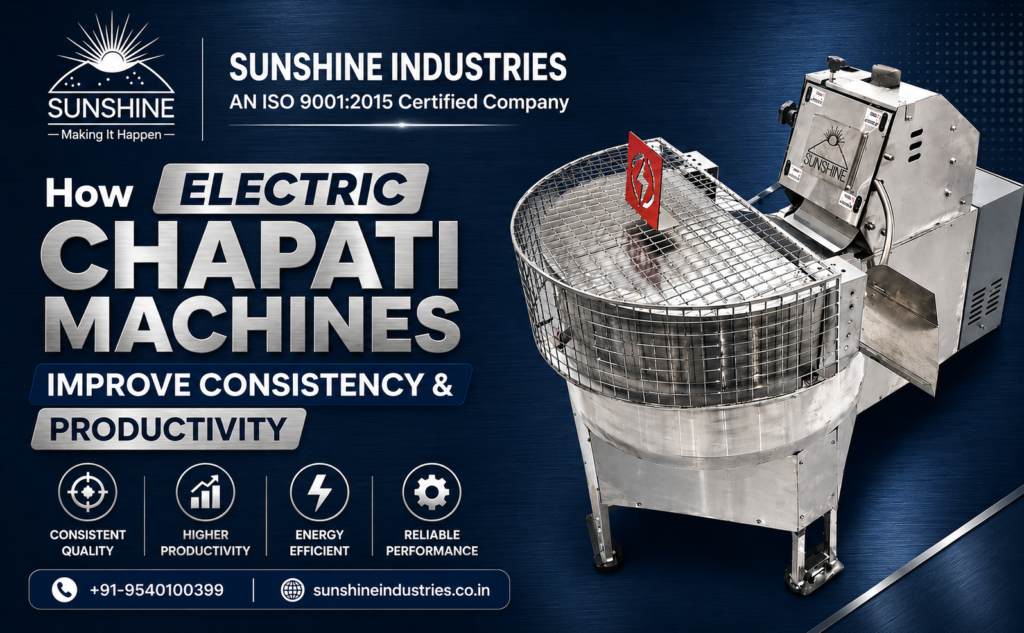
How Electric Chapati Machines Improve Consistency & Productivity
From restaurants and canteens to cloud kitchens and catering businesses — here is everything you need to know about making the switch to electric chapati machines in 2026.
| Parameter | Details |
| Market Size (2024) | USD 200 million (growing to USD 400M by 2033) |
| Electric Chapati Maker Segment | USD 40.44 million in 2024 → USD 63.11 million by 2034 |
| Top Capacity Range | 300 – 2,000 chapatis per hour |
| CAGR Growth Rate | ~4.55% annually |
| Best Suited For | Restaurants, Hotels, Canteens, Catering, Cloud Kitchens |
Introduction
The Chapati Problem Every Commercial Kitchen Knows
Every restaurant owner, canteen manager, and caterer in India knows the pain of the morning roti rush. Six hundred chapatis ordered. Three cooks were assigned. Two cooks don’t show up. The ones who do are tired by noon. Chapatis are coming out in different sizes, some undercooked, some burnt. Customers notice. Food waste is rising. Kitchen morale falls.
This is not an unusual story. It is a daily reality for thousands of food businesses across India — and it is precisely the problem that electric chapati machines were built to solve.
Electric chapati machines are no longer a luxury for large industrial kitchens. In 2026, they are accessible, affordable, and increasingly essential for any food operation producing more than 100 chapatis per service. Whether you run a small tiffin business or a large industrial canteen feeding 2,000 workers daily, the right machine can transform your kitchen efficiency, consistency, and bottom line.
This blog walks you through exactly how they work, what they deliver, and what the real numbers look like — so you can make an informed decision.
What Is an Electric Chapati Machine?
An electric chapati machine is an automated food equipment that replicates the manual process of rolling and cooking chapatis — pressing dough balls into uniform flat rounds and baking them to consistent doneness — using electrically powered heating elements, conveyor belts, and pressing mechanisms.
These machines range from compact countertop units that produce 300 chapatis per hour for small setups, to industrial-grade continuous-feed machines capable of producing up to 2,000 chapatis per hour for large canteens, NGO kitchens, and central production units.
What Are the Main Types?
1. Fully Automatic Electric Chapati Machines
The operator only needs to feed prepared dough balls into the machine. The machine handles pressing, baking, and output — automatically and continuously. Zero manual intervention after loading. Ideal for high-volume commercial kitchens.
• Capacity: 800 – 2,000 chapatis/hour
• Best for: restaurants, hotels, large canteens, catering, industrial kitchens
• Key features: adjustable thickness, temperature control, auto-pressing, conveyor baking
2. Semi-Automatic Machines
Dough ball placement is manual but pressing and baking are automated. Lower cost entry points with good productivity improvement over fully manual methods.
• Capacity: 300 – 800 chapatis/hour
• Best for: small restaurants, tiffin services, hostels, school canteens
• Key features: manual feed, automatic pressing, and cooking
3. Domestic Electric Chapati Makers
Small household appliances for making 2–5 chapatis at a time. Not suitable for commercial use. Included here for completeness only
How Do Electric Chapati Machines Improve Consistency?
Consistency is the hardest thing to achieve with manual chapati production. Every chapati a human make is slightly different — in size, in thickness, in how long it stays on the tawa, in how evenly the heat is applied. These variations compound over hundreds of chapatis, creating visible quality differences that customers notice and that lead to significant food waste.
Electric chapati machines eliminate this variability through mechanical precision.
Maintaining a uniform size, thickness, and texture when making chapati by hand is one of the most difficult challenges in commercial kitchens. A chapati machine controls cooking time and heat distribution to perfection, ensuring taste and presentation remain identical across every batch.
The Five Pillars of Machine Consistency
1. Uniform Size — Every Time
Machines press dough balls into a fixed chapati’s diameter — typically adjustable between 3 and 8 inches. Once calibrated, every chapati produced in a session is the same size. There is no variation based on how tired the cook is or how much flour was dusted. Customers serving plated meals get an identical presentation every time.
2. Precise Thickness Control
Chapati thickness can be set to within 1–3mm depending on the model. This is not achievable manually at scale. A thinner chapati cooks faster and has a different texture to a thicker one — with a machine, this choice is locked in and reproducible, not dependent on individual skill.
3. Controlled, Balanced Heat Distribution
The electric heating system in a commercial chapati machine delivers calibrated, even heat across the entire cooking surface simultaneously. Unlike gas flames or manual tawas where heat varies across the surface, electric heating plates cook from both sides with equal controlled temperature — eliminating burnt spots, underdone centers, and uneven puffing.
4. Fixed Cooking Time
Manual cooking time varies based on the cook’s attention, distraction, and experience. A machine’s conveyor belt speed or press duration is set precisely — every chapati receives the same cooking duration, producing identical doneness across an entire production run.
5. Standardised Weight
Advanced models control chapati weight within 12–90 grams depending on settings. For food businesses that cost portions or serve fixed-weight meals (institutional catering, airlines, packaged foods), this is critically important for both customer satisfaction and profitability.
| Consistency Parameter | Manual Production | Electric Machine |
| Size Variation | High (cook-dependent) | Zero — mechanically fixed |
| Thickness Variation | Moderate to high | Set to within 1mm |
| Cooking Uniformity | Inconsistent | Identical across every unit |
| Weight Consistency | Variable | Fixed at a set weight |
| Quality Across 500 Chapatis | Degrades as a cook tire | Identical from first to last |
How Do Electric Chapati Machines Improve Productivity?
Consistency answers the quality question. Productivity answers the volume and cost question. Electric chapati machines improve productivity on every measurable axis.
Speed: The Number That Matters Most
A skilled manual cook can produce 60–80 chapatis per hour working continuously. A semi-automatic machine operated by one person produces 300–800 chapatis per hour. A fully automatic industrial machine produces 800–2,000 chapatis per hour.
| Production Method | Chapatis/Hour | Staff Required | Consistency |
| Skilled manual cook | 60 – 80 | 1 per 60 chapatis | Variable |
| Semi-automatic machine | 300 – 800 | 1 operator | High |
| Fully automatic machine | 800 – 2,000 | 1 operator | Perfect |
Real example: A canteen serving 500 workers requires approximately 1,500 chapatis per lunch service. Manually, this requires 4-5 dedicated cooks working for 2.5-3 hours. A single fully automatic machine with one operator completes the same output in under 90 minutes. The kitchen frees up to 3-4 people for other preparation tasks.
Labour Cost Reduction
Labour cost is the largest operational expense in any commercial kitchen. A skilled chapati cook in India earns \u20b915,000–\u20b930,000 per month depending on the city. A busy restaurant employs 2–3 dedicated chapati cooks. That is \u20b930,000–\u20b990,000 per month in salaries for chapati production alone.
An electric chapati machine reduces this to one operator — who may also handle other tasks during production. The labour cost saving typically ranges from Rs.920,000 to Rs. 960,000 per month depending on operation size, with machines recovering their investment cost within 6–18 months.
• Fully automatic machines reduce chapati staffing from 3–4 cooks to 1 operator
• Operator does not need to be a skilled cook —training takes hours, not months
• Reduced dependency on skilled labour availability and attrition
• No overtime costs during peak production periods
Eliminating the Peak-Hour Bottleneck
In manual kitchen operations, the chapati station is consistently the biggest bottleneck during peak hours. Slow chapati output delays entire meal service, creates queues, reduces customer satisfaction, and puts pressure on all other kitchen staff.
An electric machine with consistent throughput eliminates this bottleneck. Because output speed is fixed and mechanical, it is immune to the chaos of peak-hour pressure that affects human performance.
Reduced Food Waste
Manual chapati production results in a meaningful percentage of waste — burnt chapatis, misshapen pieces, and undercooked batches that need to be discarded. In large-volume operations producing 500–1,000 chapatis per service, even a 5% waste rate is 25–50 chapatis per service discarded.
Machines eliminate burnt and misshapen output entirely once calibrated. Waste rates in properly maintained electric machines approach zero during normal operation.
Hygiene & Food Safety: The Underrated Benefit
Every time a human hand rolls a chapati, it introduces contact points for contamination. In a busy kitchen serving hundreds of people, hygiene risk management is a genuine operational and regulatory concern.
Electric chapati machines are built from food-grade SS-304 stainless steel — the same standard used in medical equipment. Contact surfaces are non-porous, non-reactive, and easy to sterilise. The reduction in human hand contact with food during production meaningfully reduces contamination risk.
• All food-contact parts made from SS-304 stainless steel
• Non-stick surfaces prevent dough residue build-up
• Minimal human contact with food during the production cycle
• Easy disassembly and cleaning at the end of service
• FSSAI-compliant designs available from major Indian manufacturers
Chapati-making machines are designed to meet stringent hygiene standards. They are typically made of food-grade materials and are easy to clean, helping businesses maintain compliance with food safety regulations.
Who Should Use an Electric Chapati Machine?
The honest answer: any food operation producing more than 150–200 chapatis per service will see a positive ROI from switching to even a semi-automatic machine. The business case strengthens rapidly as volume increases.
| Business Type | Recommended Capacity | Machine Type |
| Tiffin service / small restaurant | 300–500 chapatis/hr. | Semi-automatic |
| Mid-size restaurant/hotel | 700–1,000 chapatis/hr. | Fully automatic |
| Large canteen / NGO kitchen | 1,000–1,500 chapatis/hr. | Fully automatic |
| Industrial/central kitchen | 1,500–2,000+ chapatis/hr | Industrial grade |
| Cloud kitchen | 500–1,000 chapatis/hr | Fully automatic |
| Temple/Gurudwara langar | 1,000–2,000+ chapatis/hr | Industrial grade |
Key Features to Look for When Buying
1. Adjustable Thickness Settings
Essential for businesses producing different types of chapati or serving varied customer preferences. Look for a range of 1–3mm, with adjustable increments.
2. Production Capacity That Matches Your Peak Demand
Do not buy for average demand — buy for peak demand. A mid-size hotel needs 700–1,000 rotis/hour for peak service; an industrial canteen may need 1,500+. Undersized machines create the same bottleneck problem you are trying to solve.
3. Uniform Heating System
Advanced electric heating elements that distribute heat evenly across the cooking surface are the core technology. Ask manufacturers for temperature uniformity specifications.
4. Food-Grade Stainless Steel Construction (SS-304)
Non-negotiable for commercial food production. All food-contact surfaces should be SS-304 certified.
5. Built-in Chimney / Heat Ventilation
For indoor commercial kitchens, a built-in chimney removes heat and steam efficiently, keeping the kitchen environment safer and cooler. Especially important for fully electric models.
6. Easy Cleaning & Low Maintenance Design
Accessible components that can be cleaned between services without full disassembly. Ask about the cleaning time per service. Minimising downtime between services is operationally critical.
7. After-Sales Service & Spare Parts Availability
A machine that is down for a week waiting for spare parts costs far more than the repair bill. Buy from manufacturers with pan-India service networks.
Electric vs Gas Chapati Machines: Which Is Better?
| Factor | Electric | Gas |
| Operating Cost | ~0.5 units/hr electricity | ~1 kg LPG/hr |
| Safety | Higher (no open flame) | Requires gas safety protocols |
| Indoor Use | Fully suitable | Requires ventilation |
| Temperature Control | Precise electronic control | Manual flame adjustment |
| Environmental Impact | Lower emissions | LPG combustion emissions |
| Initial Cost | Slightly higher | Slightly lower |
| Maintenance | Simpler | Requires burner servicing |
For most modern commercial kitchens — particularly cloud kitchens, indoor canteens, and institutional setups — fully electric models are the recommended choice. They offer better safety compliance, more precise temperature control, and lower long-term operating costs.
The ROI Calculation: Does It Make Financial Sense?
For a mid-size restaurant or hotel kitchen, here is a conservative ROI estimate:
| Cost / Saving | Monthly Estimate |
| Labour saved (2 cooks at ₹20,000 each) | ₹40,000/month saved |
| Food waste reduction (5% less waste on 600 chapatis/day) | ₹3,000–5,000/month saved |
| Fuel savings (electric vs gas) | ₹1,500–3,000/month saved |
| Total monthly savings (conservative) | ₹44,500 – ₹48,000/month |
| Machine cost (fully automatic, mid-range) | ₹3–5 lakh (one-time) |
| Estimated payback period | 7 – 11 months |
Beyond the direct savings, the indirect benefits — consistent quality leading to better customer retention, removal of production bottlenecks, reduced dependence on skilled staff availability — add meaningful long-term value that does not appear in a monthly savings calculation.
FAQ: Electric Chapati Machines
How many chapatis can an electric machine produce per hour?
Capacity ranges from 300 chapatis/hour for semi-automatic entry-level models to 2,000+ chapatis/hour for industrial-grade fully automatic machines. Most commercial restaurants and hotel models produce 800–1,000 chapatis per hour.
Do electric chapati machines require skilled operators?
No. One of the primary advantages is that operators do not need chapati-making skills. A trained operator can learn machine operation in a few hours. The machine handles the skill-dependent parts of the process automatically.
What is the electricity consumption of a commercial chapati machine?
Most commercial electric chapati machines consume approximately 0.5 units (kWh) per hour of operation. At standard Indian commercial electricity rates, this amounts to roughly ₹3–5 per hour of production, making it highly energy-efficient compared to gas alternatives.
Can chapati machines make different sizes of chapati?
Yes. Most commercial machines offer adjustable size settings, typically producing chapatis between 3 and 8 inches in diameter. Thickness is also adjustable, typically from 1 to 3mm.
How long does it take to clean a commercial chapati machine?
Most well-designed commercial machines can be cleaned in 15–25 minutes at the end of service. Food-grade stainless steel surfaces and non-stick cooking plates are designed for efficient cleaning without full disassembly.
Is an electric chapati machine suitable for Indian bread varieties other than chapati?
Yes. Most commercial chapati machines also produce roti, phulka, and paratha (plain). Some models support regional variations. Naan and puri typically require different equipment due to their cooking method.
What is the market size of the electric chapati maker industry?
The overall automatic chapati-making machine market was valued at USD 200 million in 2024 and is projected to reach USD 400 million by 2033. The electric chapati maker segment specifically was valued at USD 40.44 million in 2024 and is forecast to grow to USD 63.11 million by 2034 at a CAGR of 4.55%.
Conclusion
The Kitchen of Tomorrow Is Already Here
The change from making chapatis by hand to using a machine is not about old ways versus new ways. It is simply a decision that businesses make when they think about how good their chapatis are, how much they cost, and how many they can make.
When someone cooks chapatis by hand, they can make about 60 to 80 chapatis in one hour. They are not all the same. On the other hand, a big electric machine can make 800 to 2,000 chapatis in one hour, and they are all identical. This machine only needs one person to operate it. All the chapatis are just as good as each other.
We know that using a machine can save businesses money on labor, reduce waste, and make sure all the chapatis are the same. This is not an idea. Many businesses have already started using these machines and have seen these benefits. The market for chapati machines is getting bigger with a growth rate of 4.55 percent every year. This is because many commercial kitchens in India are realizing that using a machine is a good idea.
The shift from manual chapati production to electric machine production is not a question of tradition versus modernity. It is a straightforward business decision that sits at the intersection of quality, cost, and scale.
A manual cook produces 60–80 chapatis per hour with inevitable variation. A commercial electric machine produces 800–2,000 identical chapatis per hour, staffed by one operator, with zero quality degradation across the run.
The numbers on labour savings, waste reduction, and consistency are not theoretical — they are documented across thousands of operations that have already made this transition. The market is growing at 4.55% annually, reflecting commercial kitchens across India reaching the same conclusion.
If your kitchen produces more than 150 chapatis per service, the investment case for an electric chapati machine is compelling. The only question worth asking is not whether to automate, but which model fits your current volume and your growth ambitions.