
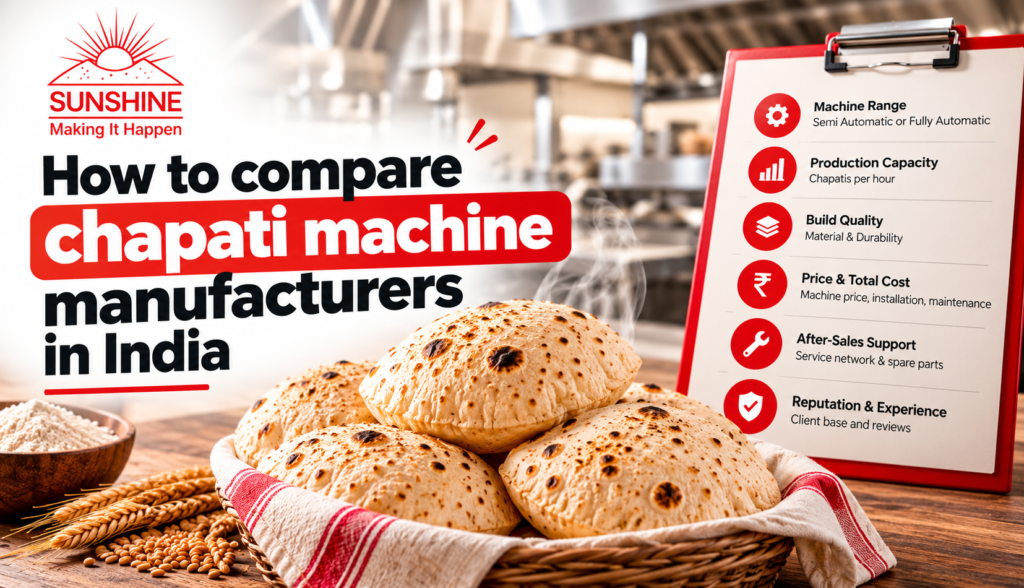
How to compare chapati machine manufacturers in India
Almost every manufacturer claims the same things: best quality, highest output, lowest price. Here are the questions that actually separate them — and what the answers tell you.
Target keyword: chapati machine manufacturer + Coimbatore cluster (~630/mo)
Suggested slug: /how-to-compare-chapati-machine-manufacturers-india/
Meta title: How to Compare Chapati Machine Manufacturers in India (Coimbatore, Noida and Beyond) | Sunshine Industries
Meta description: India’s chapati machine manufacturing is clustered in a few cities. How to evaluate suppliers objectively — build quality, real output, service reach, export capability — and what to ask on a factory visit.
If you’ve been collecting quotes, you’ve probably noticed that the brochures are interchangeable. Same adjectives, same claims, wildly different prices. The differences that matter are mostly invisible from a website — which is why this page is a set of questions rather than a comparison table.
Where chapati machines are made in India
Manufacturing in this category clusters in a few places, largely because of local engineering ecosystems rather than anything about the product.
Coimbatore has a deep engineering and light-machinery base, and a number of food processing equipment manufacturers operate there. If you’re in Tamil Nadu or the south, a local supplier means short service distances.
Noida and the Delhi NCR belt has strong fabrication and stainless steel supply chains and good export logistics through Delhi. Sunshine has manufactured here since 2007.
Ahmedabad, Rajkot and parts of Gujarat also host food machinery manufacturers, with a strong presence in the broader kitchen equipment sector.
Location on its own tells you little about quality. What it does affect is service distance and freight cost — and those are worth weighing, because a heavy machine is expensive to move and a technician six hours away is a different proposition from one six hundred kilometres away. Ask any supplier, wherever they’re based, how they cover your city specifically.
Eight questions that actually differentiate suppliers
- How long have they manufactured this specific product?
- General kitchen equipment experience is not the same as chapati machine experience. Ask when they built their first unit and what’s changed in the design since. Long product history means the failure modes have been found and engineered out — that knowledge only comes from machines running in real kitchens for years.
- Ask: “When did you sell your first chapati machine, and what’s changed in the design since then?”
- What is the real output, not the brochure output?
- Peak theoretical throughput and sustained real-world output are different numbers. Dough consistency, operator rhythm and thermal recovery all reduce the headline figure. A supplier confident in their machine will give you a tested sustained figure, and let you verify it.
- Ask: “What does this machine sustain over a two-hour service with my dough — and can I see that?”
- What is the fuel and power consumption per 1,000 chapatis?
- This is the question most buyers skip and later regret. At a million rotis a year, a modest difference in LPG per thousand pieces becomes a large annual figure. It can easily exceed the price difference between two machines within the first couple of years.
- Ask: “What is LPG and electricity consumption per 1,000 chapatis?”
- How is the machine cleaned?
- Look specifically for hidden enclosures and cavities. Anywhere atta can collect and not be reached is a cleaning burden every single day and a pest risk over time. Machines designed without hidden spaces are quicker to clean and pass hygiene audits more easily.
- Ask: “Show me every place flour can collect, and how I reach it.”
- What material and gauge is the build?
- Food-grade stainless steel throughout, not just on visible panels. Frame gauge, motor rating and burner assembly quality are where cost differences usually sit. Weight is a rough proxy — fully automatic units typically run between 700 and 1,800 kg, and a machine substantially lighter than its class is usually lighter somewhere structural.
- Ask: “What grade of steel, and what does this model weigh?”
- Where is the nearest technician and what’s the response time?
- For a kitchen with a contract to fulfil, downtime is the real risk. Get a specific answer about your city, not a general claim about pan-India service. Ask whether they have a local partner or send from the factory.
- Ask: “If my machine stops on a Friday in my city, what happens?”
- Are spare parts stocked, and what do wear items cost?
- A machine is only as good as its spare parts supply. Ask what the consumable and wear items are, what they cost, and whether they’re held in stock in India. A supplier who can answer this immediately has a real service operation behind them.
- Ask: “What are the wear parts, what do they cost, and are they in stock now?”
- Can you see the machine running under load?
- The single most useful thing you can do. At the factory, or better, in an existing customer’s kitchen during actual service. A manufacturer with installations they’re proud of will arrange it. Reluctance here is the clearest signal you’ll get.
- Ask: “Can I visit a customer running this model?”
Reference checks are underused
Ask for two or three customers running the same model you’re considering, and call them. Ask what’s broken, how long it took to fix, and whether the output matched what was promised. Most buyers never do this, and it’s the most reliable information available to you.
Warning signs
- A firm price quoted before anyone has asked your required output
- Output claims with no consumption figures attached
- Vagueness about who services the machine in your city
- No customer references available for the specific model
- Reluctance to let you see the machine running under load
- Warranty terms that aren’t written down
What we’d say about ourselves
Sunshine has manufactured commercial chapati machines in Noida since 2007, when the first unit went to IIT Roorkee. We now build over 20 models across three mechanisms — triple conveyor, wedge press rotary and rotary indexing — covering 300 to 2,000 chapatis an hour, and we’ve supplied more than 5,000 customers across 15 countries, exporting since 2011.
Rather than ask you to take that on trust, we’d rather you put the eight questions above to us, and to everyone else you’re considering. We’ll give you consumption figures, wear part costs, a specific service answer for your city, and an existing customer you can call. If someone else answers better, buy from them.
To go deeper on specifics, see our price guide, our breakdown of which machine does what, and our customer list.
Frequently asked questions
Where are chapati making machines manufactured in India?
Manufacturing clusters around a few engineering centres — Coimbatore in Tamil Nadu, the Noida and Delhi NCR belt, and parts of Gujarat including Ahmedabad and Rajkot. Location mainly affects service distance and freight cost rather than quality; ask any supplier how they cover your specific city.
Does it matter whether I buy locally or from another state?
It matters for two practical reasons: freight on a heavy machine, and how quickly a technician can reach you. Many manufacturers operate service networks or local partners well outside their home city, so ask for a specific answer about your location rather than assuming distance is decisive.
How do I verify a manufacturer’s output claims?
Ask for sustained output over a realistic service period rather than peak theoretical throughput, ask to see the machine running under load, and speak to an existing customer running the same model. Any of the three is more reliable than a brochure figure.
What certifications should a chapati machine manufacturer have?
Look for quality management and food safety related certifications, and for export orders, compliance documentation relevant to your destination country. Ask what certifications apply to the specific model you’re buying rather than to the company generally.
Should I choose the cheapest quote?
Only after you’ve compared fuel consumption, spare part costs, service reach and build specification. A lower purchase price with higher LPG consumption and no local service frequently costs more within two years than the quote it undercut.
Put these questions to us
Ask for consumption figures, wear part costs, service coverage in your city, and a customer reference for the model you’re considering. We’ll answer all four.
Contact: +91-9818172990 | +91-0120-4337946 | info@sunshineindustries.co.in