
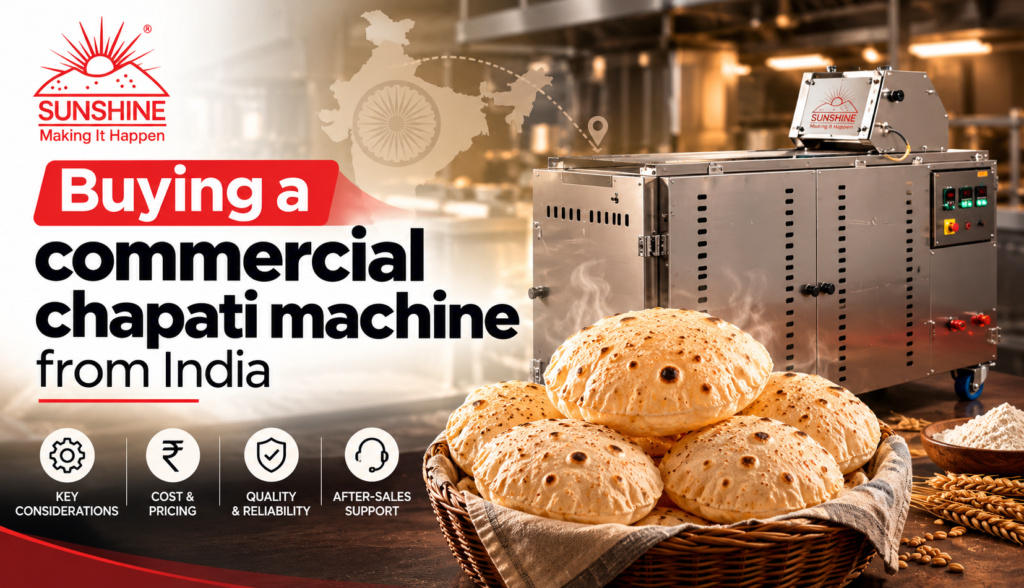
India makes most of the world’s commercial roti equipment, which is why buyers from the Gulf to East Africa source here. The hard part isn’t finding a machine — it’s landing it, powering it and servicing it once it arrives.
Target keyword: chapati machine exporter india / import from india
Suggested slug: /importing-chapati-machine-from-india/
Meta title: Buying a Commercial Chapati Machine from India: A Guide for International Buyers | Sunshine Industries
Meta description: How to import a commercial chapati or roti making machine from India — incoterms, shipping and duties, certification, voltage and gas compatibility, remote demos and after-sales support abroad.
If you run a kitchen outside India — a restaurant in Dubai, a catering business in Nairobi, a gurdwara in Toronto, a hotel in Kuala Lumpur — buying a chapati machine means dealing with shipping, customs, electrical compatibility and after-sales support across a border. None of it is difficult, but all of it needs settling before you pay.
This page covers what an international purchase actually involves and what to confirm with any Indian supplier before you commit.
Understand the incoterms before you compare prices
Two quotes for the same machine can differ enormously simply because one includes shipping and the other doesn’t. Establish which term you’re being quoted on before comparing anything.
FOB — Free On Board
You handle: sea freight, insurance, destination duties and clearance
The price covers the machine delivered to the Indian port and loaded. Cheapest headline number, most work for you. Sensible if you have a freight forwarder you already use.
CIF — Cost, Insurance and Freight
You handle: destination duties, clearance and inland delivery
The price covers the machine shipped and insured to your destination port. The usual middle ground for buyers who can manage customs locally but don’t want to arrange shipping.
DDP — Delivered Duty Paid
You handle: unloading at your premises
The price covers everything to your door including duties. Highest headline number, least work and least uncertainty. Usually worth it for first-time importers.
Sunshine quotes FOB, CIF or DDP depending on order size. Tell us your destination port or address and which term you want, and we’ll price it accordingly.
What changes between countries
Duties and import taxes
These vary considerably by country and by HS classification, and they’re the largest variable in your landed cost. Get an indication from your local customs broker before ordering, using the HS code we provide, rather than discovering it at clearance.
Electrical supply
Voltage, phase and frequency differ across markets. Confirm your supply specification with the manufacturer before production, not after shipping — motors and control systems need to be built for your supply.
Gas type and supply
Our machines bake on gas burners. LPG composition, cylinder or line pressure, and connection standards vary by country. Tell us what you have available and we’ll confirm compatibility or adjust the burner specification.
Certification and documentation
Our machines carry warranty and are built to food safety and international quality norms. Where your country requires specific certification for imported food equipment, tell us at the time of order and we can provide documentation to match. It’s much easier arranged before shipping than after.
Ask for a video demonstration first
You shouldn’t buy a machine of this size sight unseen. We provide video demos and detailed footage of the specific model running under load. We can also arrange a factory inspection at our Noida facility, or through a local partner where one is available in your region.
How an export order runs
- Share your requirement
- Your peak-hour roti requirement, available floor space, electrical supply specification, gas type, and destination port or address. These five determine everything that follows.
- Model recommendation and video demo
- We propose a model and capacity, and send footage of it running. This is the point to ask about sustained output, fuel consumption and cleaning access — see our supplier evaluation questions.
- Quotation on your chosen incoterm
- A written quote as FOB, CIF or DDP, with HS code and machine specification so your customs broker can estimate duties.
- Order confirmation and build
- Electrical and gas specifications are locked in here, along with any customisation — chapati diameter, thickness, footprint adjustments.
- Pre-shipment inspection
- Factory inspection in person, via a local partner, or by video of your actual machine running before it’s crated.
- Shipping and documentation
- Commercial invoice, packing list, bill of lading and certificates of origin as required by your destination.
- Installation and training
- Through a local agent where we have one, otherwise remote guided installation with video support. We recommend training more than one operator.
After-sales support abroad
This is the question that decides whether an import works out, and it deserves a direct answer. Where we have local agents or importers, service and spare parts are handled through them. Where we don’t, we ship spare parts directly and provide remote support. Our machines are deliberately built to be serviceable — food-grade stainless steel construction, conventional mechanical components, no proprietary parts that only one technician can touch.
Before ordering from anyone, ask two things: what the wear parts are and what they cost, and what the process is if something fails in your country. Keep a small spare-parts float with the initial shipment — it costs very little alongside the machine and saves weeks later.
Confirm before you pay
- Which incoterm the quote is based on
- HS code, and an estimated duty figure from your local broker
- Voltage, phase and frequency the machine will be built for
- Gas type and pressure compatibility
- Sustained output, and fuel consumption per 1,000 chapatis
- Machine dimensions and crated weight, against your access route
- Warranty terms in writing, and how they apply outside India
- Spare parts list, prices, and the support process in your country
- Any certification your country requires for imported food equipment
Where we already ship
Sunshine has exported since 2011 and serves customers across the Middle East, Southeast Asia and Africa, including Nepal, Bangladesh, Kenya and the UAE. We’re continuing to expand — if your country isn’t on that list, tell us where you are and we’ll confirm whether we already serve there or can arrange export.
For machine selection itself, our guide to which machine does what and the semi automatic vs fully automatic comparison are the best places to start.
Frequently asked questions
Does Sunshine Industries export chapati making machines?
Yes. We have exported since 2011 and serve customers across the Middle East, Southeast Asia and Africa, including Nepal, Bangladesh, Kenya and the UAE. Send us your destination and we’ll confirm whether we already serve there or can arrange export.
How do shipping and import costs work for an international order?
Shipping, customs duties and import taxes depend on your country. We quote FOB, CIF or DDP depending on order size. Share your shipping address or destination port for an accurate figure, and use the HS code we provide to get a duty estimate from your local broker.
Will the machine work with my country’s electrical supply?
Confirm your voltage, phase and frequency at the time of order so the machine is built for your supply. This needs settling before production rather than after shipping.
Is after-sales support available internationally?
Yes. Where possible we provide service and spare parts internationally. For countries outside India we work with local agents or importers; otherwise we ship spare parts directly and provide remote support.
Can I inspect the machine before it ships?
Yes. We offer video demonstrations and detailed footage of the machine in operation, and can arrange inspection at our Noida factory or via local partners where available. We’d encourage a pre-shipment check on your actual machine.
What about warranty and certification for export machines?
All machines come with warranty and are built to food safety and international quality norms. Where your country requires specific certifications, request them at the time of order and we’ll provide documentation accordingly.
Shipping to your country?
Send us your destination port, required output per hour, and your electrical and gas specifications. We’ll come back with a model, a video of it running, and a quote on your preferred incoterm.
Contact: +91-9818172990 | +91-0120-4337946 | info@sunshineindustries.co.in