
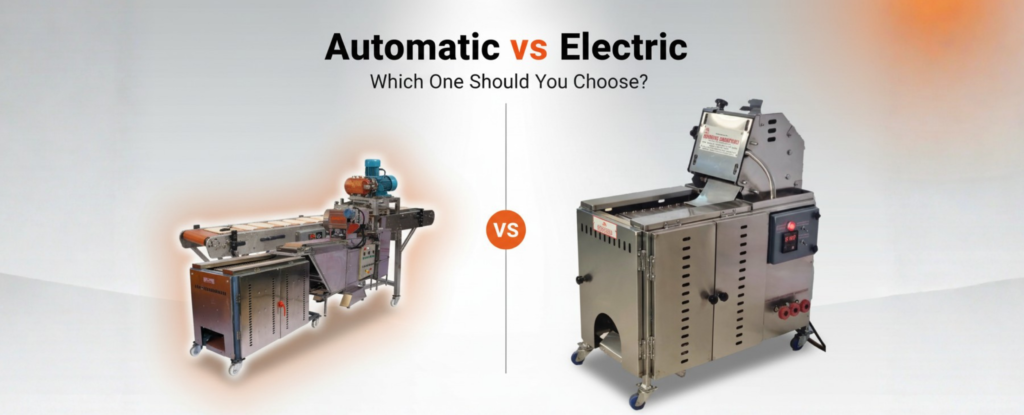
Automatic Roti Maker vs Electric / Basic Roti Maker
Making rotis in large numbers can be tiring and time-consuming. That’s why many kitchens today use automatic roti maker machines to simplify the process. These machines make chapati production faster, more hygienic, and more efficient.
However, before selecting a machine, it is important to understand which type of chapati-making machine best suits your needs.
Many buyers often get confused between:
- Automatic Roti Maker Machines (commercial)
- Electric or Basic Roti Makers (domestic)
Understanding the difference will help you choose the right equipment for your kitchen or business.
Difference Between Automatic Roti Maker and Electric / Basic Roti Maker
Automatic Roti Maker / Chapati Making Machine
An automatic roti maker machine is a heavy-duty commercial appliance designed for bulk production.
These machines:
- Take the dough or the dough balls automatically
- Press and shape the chapati
- Bake and puff the roti using controlled heat
They use conveyor systems, burners, and electric heating mechanisms to perform the entire process with minimal human involvement.
Automatic machines are ideal for:
- Hotels
- Restaurants
- Hostels
- Industrial kitchens
- Catering businesses
Their primary advantage is high production capacity and consistent quality.
Electric / Basic Roti Maker
Electric roti makers are smaller kitchen appliances designed mainly for home use.
These machines:
- Make only a few rotis at a time
- Require manual dough placement and pressing
- Are suitable for small families
They are also known as:
- Domestic roti makers
- Basic roti makers
- Semi-automatic roti makers
In simple terms:
- Automatic roti maker = commercial machine for bulk production
- Electric roti maker = small appliance for home kitchens
Benefits of Commercial Automatic Roti Makers
Automatic roti makers offer several advantages for commercial kitchens.
1. Saves Time
These machines produce rotis quickly, reducing the time spent in manual preparation.
2. Less Effort
There is no need to knead, roll, or cook rotis manually. The machine performs the pressing and baking automatically.
3. Consistent Quality
Every roti produced has the same:
- Size
- Shape
- Thickness
This ensures a uniform dining experience for customers.
4. Ideal for Large Groups
Automatic machines are perfect for places where hundreds of rotis are required daily, such as:
- Schools
- Hostels
- Restaurants
- Industrial canteens
5. Clean and Hygienic
Since machines reduce human contact with dough and food surfaces, they improve hygiene during food preparation.
6. Saves Labour Cost
Commercial kitchens can reduce the need for large kitchen staff, lowering operational costs.
Limitations of Automatic Roti Makers
Although automatic machines offer many benefits, there are a few considerations to keep in mind.
1. Higher Initial Cost
The machine, installation, and setup require a significant initial investment.
2. Space Requirements
Commercial machines need proper space, ventilation, and power connections in the kitchen.
3. Maintenance
Regular cleaning and servicing are required to keep the machine operating efficiently.
4. Limited Flexibility
These machines are optimized for standard rotis and may not work well for extremely thick or irregular flatbreads.
5. Staff Training Required
Kitchen staff need basic training to operate and maintain the machine correctly.
Electric / Basic Roti Makers (Domestic Machines)
These small roti makers are designed mainly for home kitchens or small eateries.
Advantages
Low Cost
They are much cheaper than commercial machines.
Compact Size
Small and easy to store in compact kitchens.
Suitable for Small Families
Perfect when only a few rotis are needed.
Easy Maintenance
Cleaning and operation are simple.
Limitations
Low Output
These machines can produce only a few rotis at a time.
Inconsistent Quality
Rotis may not always puff or remain soft.
Not Suitable for Commercial Use
They cannot handle continuous, high-volume cooking.
Types of Commercial Roti Maker Machines
Commercial roti-making machines come in different configurations depending on capacity and usage.
| Type / Model | Best Use Case |
| Triple Conveyor Type (300–2000 rotis/hr) | Restaurants, hostels, industrial kitchens |
| Wedge Press Rotary Type (300–1000 rotis/hr) | Medium hotels, caterers, hostels |
| Rotary Indexing Type (1000 rotis/hr) | Busy kitchens, large canteens |
| Electric / Domestic Roti Maker | Homes or small eateries |
Manufacturers such as Sunshine Industries offer several of these commercial-grade machines suitable for different kitchen sizes.
Which Roti Maker Is Best for You?
| Use Case | Best Option |
| Large restaurants, hotels, and catering companies | Automatic Roti Maker |
| Hostels, canteens, mid-size kitchens | Mid-capacity automatic machines |
| Small dhabas or eateries | Electric/basic roti maker |
| Home kitchens | Electric roti maker |
From a business perspective, automatic machines offer better speed, hygiene, and return on investment for commercial kitchens.
Frequently Asked Questions (FAQs)
Q1. Can a commercial automatic roti machine replace skilled roti rollers?
Yes. Automatic machines can press and bake rotis with minimal human intervention, producing uniform rotis at high speed.
Q2. Are machine-made rotis as good as handmade rotis?
Machine-made rotis are usually consistent in size, softness, and cooking quality. Many restaurants prefer them for their uniformity and hygiene.
Q3. What are the cost and space requirements?
Commercial machines require a higher upfront investment and dedicated installation space.
Q4. Can small kitchens use automatic roti machines?
For small kitchens or occasional cooking, a basic electric roti maker is more practical.
Q5. Can these machines make other flatbreads?
Most machines are optimized for rotis and chapatis, though some may handle similar flatbreads.
Final Recommendation
If you are running a restaurant, hotel, catering service, or hostel kitchen, investing in a commercial automatic roti maker machine is the smarter choice.
For small to medium kitchens, a mid-capacity machine producing 300–700 rotis per hour works well. For high-demand kitchens, machines capable of 1000–2000 rotis per hour are more suitable.
Automatic machines provide:
- Faster production
- Consistent quality
- Better hygiene
- Reduced labour costs
While electric roti makers are useful for home kitchens, they are not designed for commercial operations.
For businesses focused on efficiency and scalability, investing in a reliable automatic roti maker solution is the best long-term decision.