
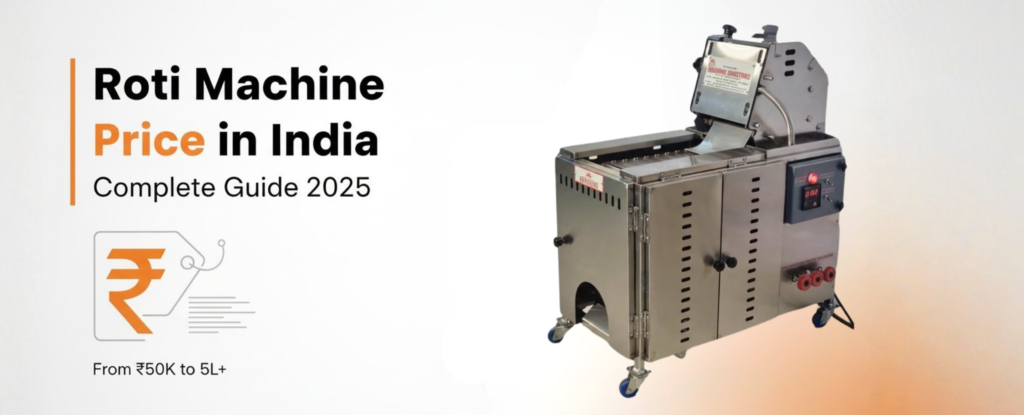
Before planning to open or set up a hotel, restaurant, catering service, hostel kitchen, or NGO meal program in India, one of the most important decisions you will make is choosing the right commercial roti or chapati-making machine.
A good machine helps make rotis faster, more consistently, and with less labour. However, with many options available in the market, it’s important to choose a machine that fits your production needs and budget.
In this guide, we’ll break down the typical price range of commercial roti-making machines in India for 2025, the types of machines available, and how to select the best one for your business.
This guide covers:
- Typical price ranges in India
- Factors that affect machine pricing
- Types of commercial roti machines
- Commercial vs domestic roti makers
- Why commercial machines are worth the investment
Typical Price Range of Commercial Roti Making Machines in India
Commercial roti-making machines in India generally fall into the following price categories based on production capacity.
| Capacity & Use | Approx Price Range (INR) |
| Entry-Level / Small Output (300–500 rotis/hour) | ₹80,000 – ₹1,50,000 |
| Mid-Range Commercial (700–1000 rotis/hour) | ₹1,50,000 – ₹3,00,000 |
| High-Capacity Industrial (1500–2000+ rotis/hour) | ₹3,00,000 – ₹6,00,000+ |
[These are ballpark figures based on typical commercial offerings in the Indian market as of 2025. Prices vary with brand, build quality, capacity, and features.]
What Affects the Price of a Commercial Roti Machine?
Several factors influence the cost of a commercial chapati-making machine.
1. Production Capacity
Machines that produce more rotis per hour typically cost more. For example, a 300–500 roti/hour machine is significantly cheaper than one producing 1500–2000 rotis/hour.
2. Automation Level
Fully automatic machines that press, cook, and bake rotis automatically are more expensive. Semi-automatic machines, where some steps are manual, usually cost less.
3. Build Quality and Materials
Machines made from food-grade stainless steel and durable components cost more but provide better hygiene and a longer lifespan.
4. Brand and After-Sales Support
Well-known manufacturers often charge more but provide better reliability, spare parts availability, and service support.
5. Additional Features
Extra features such as:
- Adjustable thickness settings
- Temperature control
- Safety systems
- Energy efficiency
- Ergonomic design
It can also increase the machine’s price.
Types of Commercial Roti Making Machines
Commercial machines are typically categorized based on production capacity and business needs.
1. Small Output Machines
Capacity: 300–500 rotis/hour
Best for:
- Small restaurants
- Small hostels
- Small kitchen setups
Pros
- Affordable
- Compact size
- Easy to install
Cons
- Lower production capacity
Typical Price
₹80,000 – ₹1,50,000
2. Mid-Range Machines
Capacity: 700–1000 rotis/hour
Best for:
- Restaurants
- Mid-sized hotels
- Catering businesses
Pros
- Balanced output and price
- Reliable performance
Cons
- Requires moderate kitchen space
Typical Price
₹1,50,000 – ₹3,00,000
3. High-Capacity Industrial Machines
Capacity: 1500–2000+ rotis/hour
Best for:
- Large kitchens
- Institutional food services
- Industrial catering
- Large canteens
Pros
- Very high production capacity
- Suitable for large-scale operations
Cons
- Higher initial investment
- Requires a larger installation space
Typical Price
₹3,00,000 – ₹6,00,000+
HCommercial Roti Machines vs Electric / Home Roti Makers2
| Feature | Commercial Machine | Electric / Home Roti Maker |
| Output | High (300–2000/hr) | Low (≈15–50 at a time) |
| Consistency | Excellent | Moderate |
| Labour savings | Strong | Limited |
| Build quality | Heavy duty | Light/home use |
| Best for | Restaurants, hostels, NGOs | Home kitchens |
For businesses producing hundreds of rotis daily, a home electric roti maker is not suitable, as it cannot handle continuous high-volume production.
Why Commercial Roti Machines are a Smart Investment
1. Saves Labour Costs
Only one operator is needed instead of multiple workers making rotis manually.
2. Faster Production
Machines produce rotis continuously and quickly, helping kitchens handle peak meal hours efficiently.
3. Consistent Quality
Every roti is uniform in size, thickness, and cooking, which improves food presentation and customer satisfaction.
4. Better Hygiene
With minimal hand contact and food-grade materials, the cooking process becomes more hygienic.
5. Strong Long-Term ROI
Although the initial investment is higher, businesses save money through:
- Reduced labour costs
- Faster production
- Less food wastage
Tips Before Buying a Commercial Roti Making Machine
1. Estimate Your Daily Roti Requirement
Determine how many rotis you need per hour or per day to select the right machine capacity.
2. Check Service Support
Ensure the manufacturer provides local service and maintenance support.
3. Verify Spare Parts and Warranty
Choose brands that offer easy spare part availability and warranty coverage.
4. Choose Food-Grade Materials
Machines built with stainless steel and food-safe materials ensure better hygiene and durability.
5. Evaluate Energy Consumption
Compare electricity or gas consumption between models to manage operating costs.
H2
Conclusion
In India, the price of commercial roti-making machines can range from ₹80,000 to ₹6,00,000+, depending on:
- Machine capacity
- Automation level
- Brand
- Build quality
- Additional features
Before buying, businesses should consider:
- Daily roti production needs
- Available kitchen space
- Budget and expected ROI
- Service and maintenance support
For most restaurants, hotels, hostels, and catering services, a mid-range automatic chapati-making machine provides the best balance of cost, performance, and long-term value.
FAQs
1. What is the price of a commercial roti-making machine in India?
Commercial roti-making machines in India usually cost ₹80,000 to ₹6,00,000+, depending on capacity, automation level, brand, and build quality.
2. Which roti-making machine is best for restaurants and hotels?
A fully automatic commercial roti machine producing 700–1000 rotis per hour is generally ideal for restaurants and hotels because it ensures speed, uniformity, and reduced labour dependency.
3. How many rotis can a commercial roti machine make per hour?
Depending on the model, commercial machines can produce 300 to 2000+ rotis per hour, making them suitable for both small and large food operations.
4. Is a commercial roti-making machine better than an electric roti maker?
Yes. Commercial machines are designed for continuous heavy-duty use, while electric roti makers are meant for home kitchens and low output.
5. What factors should be considered before buying a commercial roti machine?
Key factors include:
- Daily roti production requirement
- Machine capacity
- Kitchen space availability
- Energy consumption
- Maintenance and service support