
The Game Changer Behind Every Perfect Roti
A perfect roti doesn’t begin on the tawa.
It begins with the dough.
The right consistency, proper mixing, balanced texture, and uniform kneading are the foundation of a soft, well-shaped, and evenly cooked roti. Even the most advanced automatic roti-making machine can only deliver its best results when it receives properly prepared dough.
That is why, when it comes to large-scale roti production, perfect kneaded dough is the real game changer.
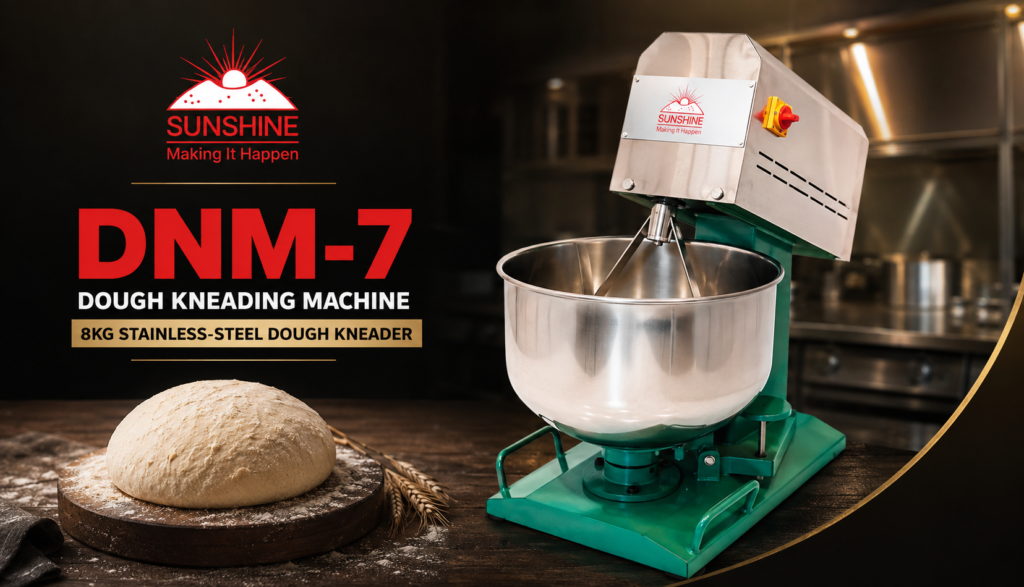
Presenting Sunshine’s DNM-7 Dough Kneading Machine, designed to help commercial and institutional kitchens prepare properly mixed, hygienic, and consistent dough with ease.
With an 8-k g of dough capacity, a stainless-steel drum and blades, and a design focused on uniform kneading, the DNM-7 is built to make one of the most important stages of roti production faster, easier, and more consistent.
Because when the dough is right, the roti gets a head start toward perfection.
Why Dough Quality Matters
Ask any experienced cook about making a good roti, and they will tell you that dough makes a huge difference.
Too hard, and the roti can become tough.
Too soft, handling and shaping can become difficult.
Unevenly kneaded dough can result in inconsistent texture and cooking.
For households, these variations can often be corrected manually. But in a commercial kitchen producing hundreds or thousands of rotis every day, consistency becomes much more important.
When large quantities of dough need to be prepared repeatedly, relying entirely on manual kneading can make it difficult to maintain the same texture from one batch to another.
This is where an efficient dough kneading machine can make a significant difference.
The Sunshine DNM-7 is designed to help kitchens achieve a more standardized dough preparation process, giving every subsequent stage of roti production a consistent foundation.
Introducing Sunshine DNM-7
The Sunshine DNM-7 Dough Kneading Machine is designed for kitchens that need reliable and efficient dough preparation for roti and chapati production.
Its purpose is simple: properly knead the dough so that it is ready for the next stage of production.
With an 8 kg of dough capacity, the machine is suitable for commercial kitchens, institutional kitchens, canteens, hotels, restaurants, hostels, catering operations, and other food-service environments where dough needs to be prepared regularly.
The DNM-7 combines practical functionality with durable construction to support everyday kitchen requirements.
Its stainless-steel drum and blades provide a robust setup for repeated dough preparation while supporting a hygienic food-production environment.
8 KG Dough Efficiency for Commercial Kitchens
One of the key features of the DNM-7 is its 8 kg of dough capacity.
For a busy kitchen, preparing dough in appropriate batches can help organize the production process more efficiently.
Instead of manually kneading dough batch after batch, kitchen teams can use the DNM-7 to streamline this repetitive task.
An 8 kg capacity makes the machine particularly useful when the kitchen needs to prepare dough regularly for large-scale roti production.
Whether it is an institutional kitchen preparing meals for students, a hotel serving guests, a restaurant managing peak hours, or a catering operation preparing food in bulk, efficient dough preparation can help keep the overall workflow moving.
The objective is not simply to knead more dough.
It is to prepare properly mixed and consistently kneaded dough that can move smoothly into the next stage of roti production.
Stainless-Steel Drum and Blades
Food-contact equipment needs to be designed with hygiene and durability in mind.
The Sunshine DNM-7 features a stainless-steel drum and blades, making it well suited for professional kitchen environments.
Stainless steel is a practical choice for commercial food equipment because it offers durability and is comparatively easy to clean and maintain when used and cared for appropriately.
For kitchens where dough preparation happens every day, the construction of the machine matters.
The DNM-7 is designed to provide a sturdy and professional dough-kneading setup that can become a dependable part of the kitchen’s daily workflow.
Its stainless-steel components also complement modern commercial kitchens where cleanliness and organized food preparation are essential.
Properly Mixed Dough for Better Roti Production
The purpose of kneading goes beyond simply combining flour and water.
Proper kneading helps develop the dough’s texture and creates a more uniform mixture.
For automated roti production, consistency at this stage is particularly important.
When dough batches vary significantly in texture or mixing, the subsequent stages of portioning, shaping, and baking can also become less predictable.
By using a dedicated dough kneading machine, kitchens can work toward achieving greater uniformity from batch to batch.
The Sunshine DNM-7 is designed to help deliver properly mixed and consistently kneaded dough, giving the roti-making process a reliable starting point.
And that is where real transformation begins.
Hygiene Meets Efficiency
In any professional kitchen, hygiene cannot be treated as an afterthought.
From ingredient handling to preparation and cooking, every stage needs to follow a clean and organized process.
Manual dough preparation can involve considerable handling, particularly when large quantities are involved.
Using a dedicated dough kneading machine can help create a more structured preparation process and reduce the need for continuous manual kneading.
The DNM-7’s stainless steel drum and blades make it suitable for commercial food-preparation environments where hygiene and durability are important considerations.
The result is a dough preparation process that is designed to be efficient, consistent, and hygienic.
Consistency Is the Secret Ingredient
Imagine producing hundreds of rotis.
You want them to look consistent.
You want them to cook consistently.
You want the texture to remain dependable.
And most importantly, you want the process to be repeatable.
That consistency starts before the dough reaches the roti-making machine.
It starts with the dough.
A standardized kneading process can help reduce variations between batches and provide a more predictable foundation for automated roti production.
This is particularly important for commercial kitchens because consistency is directly connected to operational efficiency.
When the dough is prepared consistently, kitchen teams can create a smoother production flow and better coordinate the different stages involved in making rotis.
From Perfect Dough to Perfect Roti
Think of roti production as a chain.
Good ingredients → Proper mixing → Perfect kneading → Consistent dough → Uniform processing → Proper baking → Better roti
Every stage matters.
If the dough is not properly kneaded, even an advanced roti-making machine may not be able to deliver the desired result.
That is why the DNM-7 is more than just a standalone kitchen appliance.
It can become an important part of a complete automatic roti production system.
When paired with the right roti-making equipment, a reliable dough kneading machine can help create a smoother end-to-end workflow, from preparing the dough to producing the final roti.
The Missing Link in Automated Roti Production
Many kitchens focus heavily on the final roti-making machine.
And understandably so.
Production speed, baking technology, conveyor systems, and automation are all important.
But there is one stage that should never be overlooked: dough preparation.
The final roti can only be as good as the dough that goes into the process.
This makes the dough kneading machine an important part of the overall production chain.
The Sunshine DNM-7 helps address this often-overlooked requirement by providing a dedicated solution for preparing consistent dough.
In other words, it helps bridge the gap between raw ingredients and the final perfect roti.
Designed for Commercial and Institutional Kitchens
The DNM-7 can be useful across a wide range of professional food-service environments.
Hotels and Restaurants
During peak hours, restaurants need to maintain speed without compromising food consistency. A dedicated dough kneader can help kitchen teams prepare dough efficiently and keep production organized.
Educational Institutions
Hostels, colleges, universities, and institutional campuses may need to prepare large quantities of food every day. Consistent dough preparation can support smoother chapati production for large student populations.
Industrial Canteens
Large employee cafeterias and industrial canteens often work on fixed meal schedules. Efficient dough preparation can help kitchen teams meet high-volume requirements within those schedules.
Catering Businesses
Catering operations often deal with bulk food preparation and strict timelines. A dependable dough kneading machine can help simplify one of the most repetitive preparation tasks.
Hospitals and Large Facilities
Institutional food-service environments require organized and hygienic food preparation. Equipment designed for consistent dough preparation can become a useful part of their kitchen setup.
Less Manual Effort, More Consistency
One of the key advantages of automation is reducing repetitive manual effort.
Dough kneading is physically demanding when performed continuously, especially when large quantities are involved.
By using a dedicated machine, kitchen staff can reduce the physical workload associated with repetitive kneading while creating a more standardized process.
This allows the team to focus on other important kitchen activities such as ingredient preparation, cooking, quality checks, hygiene, and service.
Automation isn’t about removing the human element from the kitchen.
It is about helping people work smarter and more efficiently.
Why Choose Sunshine DNM-7?
The DNM-7 brings together several features that make it suitable for professional dough preparation:
- 8 kg dough capacity
- Stainless-steel drum
- Stainless-steel blades
- Proper and uniform mixing
- Consistent dough preparation
- Hygiene-focused construction
- Suitable for commercial and institutional kitchens
- Helps reduce repetitive manual kneading effort
Together, these features make the DNM-7 a practical solution for kitchens looking to improve the foundation of their roti production process.
A Better Foundation for Automatic Roti Machines
An automatic roti-making machine is designed to bring efficiency to large-scale roti production.
But automation works best when every stage of the process is properly managed.
The dough is the foundation.
If the dough is inconsistent, the final production process may also become inconsistent.
If the dough is properly mixed and kneaded, the next stages can operate on a much more reliable input.
This is why the Sunshine DNM-7 can be an important companion to automatic roti-making machines.
Together, dough preparation and roti-making automation can create a more complete and efficient production line.
Perfect dough + smart automation = a better path to perfect roti.
The Real Game Changer Is Perfect Kneaded Dough
We often talk about the technology behind automatic roti production.
We talk about production capacity.
We talk about conveyor systems.
We talk about automation.
But behind every successful roti production process is one simple truth:
The quality of the dough matters.
Perfectly kneaded dough can make the entire process smoother.
- It provides consistency.
- It supports uniform processing.
- It helps standardize batches.
And ultimately, it contributes to the quality of the final roti.
That is why Sunshine believes that the journey toward the perfect roti begins much earlier than the baking stage.
It begins with perfectly kneaded dough.
From Dough to Deliciousness
A great roti is the result of multiple carefully managed steps.
- The flour needs to be prepared.
- The ingredients need to be mixed.
- The dough needs to be properly kneaded.
- The dough needs to reach the right consistency.
- The roti then needs to be processed and baked correctly.
When these stages work together, the result is a more efficient production process and a better final product.
Sunshine’s DNM-7 is designed to take care of one of the most important stages, the kneading process.
With its 8 kg capacity and stainless-steel construction, it is built to support the needs of professional kitchens looking for greater efficiency and consistency.
Conclusion: Start with the Dough
The perfect roti doesn’t start with the baking.
It starts with the dough.
And perfect dough starts with proper kneading.
The Sunshine DNM-7 Dough Kneading Machine brings efficiency, consistency, and hygiene to this essential stage of roti production. With an 8-kg of dough capacity, stainless-steel drum and blades, and a design focused on properly mixed and consistently kneaded dough, the DNM-7 is built to become a valuable part of modern commercial kitchens.
For businesses and institutions producing rotis at scale, the right dough preparation equipment can make a meaningful difference to the entire production workflow.
Because when you want the final roti to be perfect, don’t just focus on the roti machine.
Start with the dough.
Sunshine DNM-7 — Because Perfect Roti Starts with Perfect Dough.
Knead better. Produce consistently. Serve perfect rotis.