
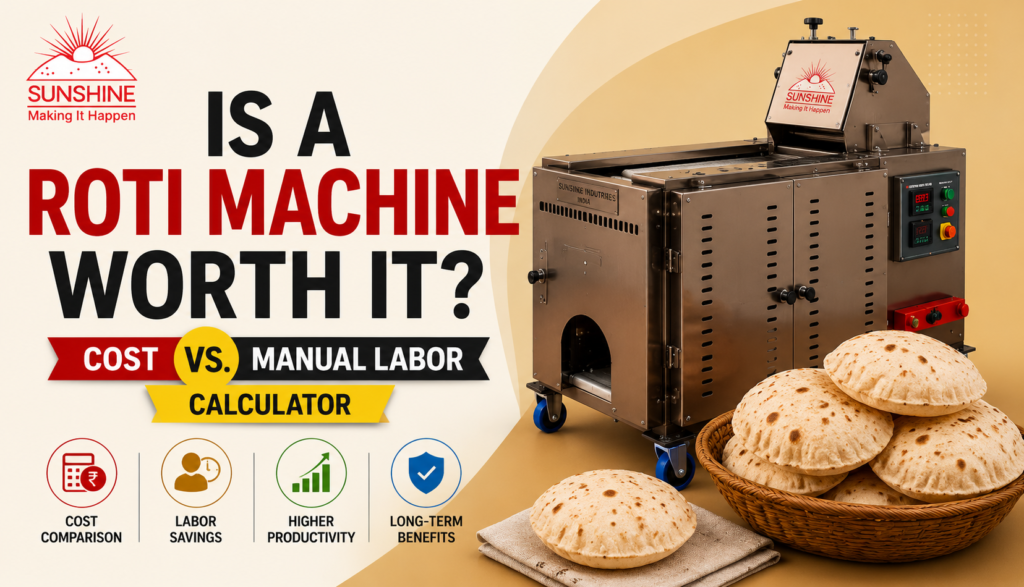
The Question Every Kitchen Owner Eventually Asks
If you are running a kitchen and every single day someone must stand at the tawa for hours, rolling and cooking roti after roti. If it is a restaurant, a canteen, a dhaba, a hotel, or a hospital kitchen, you know the rhythm, you know the cost. Somewhere in the back of your mind, you have probably wondered:
“Would a roti-making machine actually save my money?”
That is the question. A Sunshine roti-making machine is not a purchase. For commercial kitchens, a good automatic chapati-making machine from Sunshine Industries costs between ₹1,50,000 and ₹3,50,000, depending on the model and capacity. That feels like a lot of money is upfront.
Here is the thing: most kitchen owners do not sit down and calculate what two skilled chapati-makers are actually costing them every month. When you add up the picture, the numbers tell a very different story.
This blog breaks it all down clearly with numbers, simple comparisons and a straight answer to whether a Sunshine roti making machine is worth it for your kitchen in 2026.
First, let’s talk about what manual roti-making costs. Most kitchen managers think of labor cost as the monthly salary. The true cost of employing two chapati-makers is significantly higher than what you pay for each month.
Here is a realistic picture of what two skilled chapati-making workers cost a kitchen in India in 2026:
Salary: a skilled chapati cook in a commercial kitchen in India earns between ₹12,000 and ₹18,000 per month in 2026 depending on the city the kitchen type and their experience. Let us use ₹15,000 per month as a mid-range figure. For two workers that is ₹30,000 per month in salary
Food Allowance: Most commercial kitchens provide food to their kitchen staff as a benefit. A reasonable estimate is ₹1,500 to ₹2,500 per worker per month. We will use ₹2,000. For two workers, that is ₹4,000 per month.
Paid Leave: By law, workers are entitled to paid leave 1 to 1.5 days per month. On a wage of ₹500, one paid leave day per worker per month costs ₹500. For two workers at 1.5 leave days each, that is ₹1,500 per month, which is money paid for days when no roti is made.
EPF Contribution: The Employees Provident Fund requires employers to contribute 12% of the salary. On a ₹15,000 salary, that is ₹1,800 per worker per month. For two workers, that is ₹3,600 per month.
Then there are hidden costs, like absenteeism and replacement. This is the cost that nobody ever puts on paper. Every kitchen manager feels about it. A skilled chapati worker calls in sickness. You either scramble to cover the station with someone less experienced, to pay overtime to a third worker, or your production capacity drops. During hours one absent worker can disrupt the entire kitchen workflow. We will estimate this conservatively at ₹1,500 per month for casual replacement labor and overtime coverage. Sunshine roti making machine can help you with these costs. A Sunshine roti-making machine can save you money in the run. Sunshine roti making machine is an investment, for your kitchen.
The Full Monthly Cost of 2 Manual Labourers
| Cost Component | Per Worker / Month | 2 Workers / Month |
| Basic salary | ₹15,000 | ₹30,000 |
| Food allowance | ₹2,000 | ₹4,000 |
| Paid leave cost | ₹750 | ₹1,500 |
| EPF (12% of salary) | ₹1,800 | ₹3,600 |
| Absenteeism / replacement | ₹750 | ₹1,500 |
| Monthly total | ₹20,300 | ₹40,600 |
Total annual cost of 2 manual chapati workers: ₹4,87,200
That is nearly ₹5 lakh every year. Just for two people to make rotis.
And this does not even account for:
- Staff recruitment costs when someone quits
- Quality inconsistency (some days the rotis are perfect, other days they are not)
- Supervision time your senior staff spends managing the chapati station
- The physical limits on how many rotis two workers can produce in an hour
Now, let’s look at what a Sunshine Roti Making Machine Actually Costs
A Sunshine automatic chapati-making machine in the mid-range commercial segment, suitable for a restaurant, canteen, or hotel kitchen producing 600 to 1,500 rotis per hour, is priced between ₹1,50,000 and ₹2,50,000.
For this comparison, we will use ₹1,80,000 as our machine cost (a realistic mid-range Sunshine model for commercial kitchen use). This is a one-time capital expenditure.
Here is what the ongoing monthly costs look like:
Machine Purchase (Amortized Over 3 Years)
A Sunshine roti making machine has a functional life of 8 to 12 years with proper maintenance. For a conservative comparison, we amortize the purchase cost over just 3 years (36 months):
₹1,80,000 ÷ 36 months = ₹5,000 per month
That is the “monthly cost” of owning the machine when spreads over its early life. In reality, the machine continues delivering value long after the purchase cost is recovered.
Electricity
A standard Sunshine commercial chapati making machine operates on an electric motor of approximately 0.75 to 1.5 kW. Running 8 hours per day at a commercial electricity rate of roughly ₹8 per unit in most Indian cities:
1 kW × 8 hours × 30 days × ₹8 = ₹1,920 per month – we round this to ₹2,000 per month.
Maintenance and Servicing
Sunshine Industries machines are built from food-grade stainless steel and engineered for minimal maintenance. A realistic monthly provision for consumables, occasional part replacement, and periodic servicing is ₹800 to ₹1,200 per month.
We will use ₹1,000 per month.
One Machine Operator
The machine does not require a skilled chapati-maker — it needs one person to feed dough balls and manage the output. This is a semi-skilled role, paid less than a specialist chapati cook: approximately ₹10,000 to ₹12,000 per month.
We will use ₹11,000 per month including a basic food allowance.
The Full Monthly Cost of 1 Sunshine Roti Making Machine
| Cost Component | Monthly Cost |
| Machine cost (amortized over 36 months) | ₹5,000 |
| Electricity | ₹2,000 |
| Maintenance and servicing | ₹1,000 |
| 1 machine operator (salary + food) | ₹11,000 |
| Monthly total | ₹19,000 |
Total annual cost of the Sunshine machine: ₹2,28,000
The Head-to-Head Comparison
| 2 Manual Labourers | 1 Sunshine Roti Machine | |
| Monthly cost | ₹40,600 | ₹19,000 |
| Annual cost | ₹4,87,200 | ₹2,28,000 |
| Rotis per hour | 400 – 500 (both workers combined) | 600 – 1,500 (machine model) |
| Consistency | Varies — depends on mood, fatigue, skill | Same every single time |
| Sick leave / absenteeism | Yes — unpredictable | Never |
| Peak hour performance | Drops under pressure | Unchanged |
| Food hygiene | Hand-contact intensive | Minimal hand contact, food-grade SS |
| Training required | Ongoing | One-time operator training |
| Working hours | 8–10 hours max per shift | Runs as long as needed |
| Night shift premium | +20–30% extra cost | No change in cost |
Monthly saving with Sunshine machine: ₹21,600 Annual saving: ₹2,59,200
The 6-Month Savings Breakdown — Month by Month
This is where it gets really interesting. Because on Month 1, you have a large upfront machine purchase. But look at how quickly the picture changes:
| Month | Labour Cost (2 workers) | Machine Cost (incl. purchase in M1) | Monthly Saving | Cumulative Saving |
| Month 1 | ₹40,600 | ₹1,94,000 (₹1,80,000 + ₹14,000 running) | -₹1,53,400 | -₹1,53,400 |
| Month 2 | ₹40,600 | ₹14,000 | +₹26,600 | -₹1,26,800 |
| Month 3 | ₹40,600 | ₹14,000 | +₹26,600 | -₹1,00,200 |
| Month 4 | ₹40,600 | ₹14,000 | +₹26,600 | -₹73,600 |
| Month 5 | ₹40,600 | ₹14,000 | +₹26,600 | -₹47,000 |
| Month 6 | ₹40,600 | ₹14,000 | +₹26,600 | -₹20,400 |
| 6 Months Total | ₹2,43,600 | ₹2,64,000 | -₹20,400 |
Note: Running cost = ₹14,000/month (electricity ₹2,000 + maintenance ₹1,000 + operator ₹11,000). Machine purchase of ₹1,80,000 included in Month 1.
By the end of Month 6, the cumulative cost gap is only ₹20,400 — and remember, that gap closes completely by Month 7.
From Month 8 onwards, you save ₹26,600 every single month.
That means in Year 2, you save over ₹3,19,200. Year 3, another ₹3,19,200. And the machine has been running for 8 to 12 years.
When Does the Machine Pay for Itself?
At a monthly saving of ₹26,600 (after running costs), the Sunshine machine recovers its ₹1,80,000 purchase price in approximately 7 months.
After that, it is pure saving. Month after month. Year after year.
For a kitchen that was previously spending ₹4,87,200 per year on two chapati workers, switching to a Sunshine machine means the kitchen spends ₹2,28,000 per year instead, a saving of ₹2,59,200 every year from Year 2 onwards.
Over 5 years, the total savings are approximately ₹12 to ₹13 lakh for a machine that costs ₹1,80,000 to buy.
But Wait — The Machine also does more
Here is the part that the pure cost comparison does not capture fully. The Sunshine roti making machine does not just cost less than two workers. It also does more.
- Higher Output at Peak Hours
Two skilled chapati workers, working hard at peak lunch service, can produce 400 to 500 rotis per hour combined. And that output drops as they get tired.
A Sunshine automatic chapati-making machine produces 600 to 1,500 rotis per hour, consistently, regardless of what time it is or how long the service has been running. At peak hours, when your kitchen most need’s reliability, the machine delivers it every time.
- Consistent Quality — Every Single Roti
With manual production, quality naturally varies. A roti made by a tired cook at 2 PM looks different from the one made at 10 AM. Some are thicker. Some are thinner. Some puff properly; some don’t.
The Sunshine machine produces every roti to the same specification- same diameter, same thickness, same cooking level. For hotels, corporate canteens, and hospital kitchens where consistency directly affects reputation and compliance, this is not a minor benefit. It is essential.
No Sick Days. No Festivals. No Excuses.
This is the operational advantage that kitchen managers feel most acute. A Sunshine roti machine does not call in sick on a Monday. It does not take four days off for Diwali and return two days later. It does not quit suddenly before your biggest catering event.
It runs when you need it to run. That reliability alone has genuine financial value-particularly for kitchens that have ever scrambled to cover an absent chapati worker during a critical service.
Improved Hygiene
Manual chapati production involves significant hand contact with the dough throughout the rolling and flipping process. Commercial food safety standards, increasingly enforced for hotels, hospitals, and corporate kitchens, require kitchens to minimise direct hand contact with food wherever possible.
Sunshine Industries’ machines are built from food-grade stainless steel with no hidden spaces where dough or flour can accumulate and harbor bacteria. The design is specifically engineered for easy, thorough cleaning at the end of every shift. This is a hygiene upgrade that a manual process simply cannot match.
Who Should Seriously Consider a Sunshine Machine?
Not every kitchen needs a commercial roti machine. Here is an honest guide to who the investment makes the most sense for:
Strong fit:
- Restaurants and Dhaba’s serving 200+ cover per day
- Corporate canteens and office cafeterias (where peak hour volume is predictable and high)
- Hospital and healthcare catering (where hygiene standards are non-negotiable)
- Hotel kitchens managing breakfast, lunch, and dinner service
- Caterers handling large events and functions
- Cloud kitchens with high roti demand
- Industrial canteens and factory mess halls
May not be the right fit yet:
- Very small restaurants serving under 100 covers per day (the ROI timeline is longer)
- Kitchens where roti is a very small part of the menu
- Kitchens with extreme space constraints
If you fall into the “strong fit” category and you are currently employing two or more workers specifically for chapati production, the financial case for a Sunshine machine is straightforward.
Which Sunshine Machine is right for your kitchen?
Sunshine Industries has been manufacturing roti making machines for 25+ years and has served 5,000+ commercial kitchens across India and 15+ countries internationally. They offer 20+ machine models to match different kitchen sizes, production volumes, and budgets.
For kitchens producing 300–700 rotis per hour: The mid-range Sunshine automatic chapati making machine (Wedge Press or Rotary Indexing type) is the right starting point. Compact, reliable, and easy for a single operator to manage.
For kitchens producing 700–2,000 rotis per hour: The Sunshine Triple Conveyor or Slim models deliver higher output while maintaining the same consistency and food-grade build quality.
For very high-volume operations (hospital kitchens, large corporate canteens, industrial mess halls): Sunshine’s fully automatic production line integrates dough ball portioning, pressing, and cooking in a single unit — delivering up to 2,000+ rotis per hour with one operator.
Every Sunshine machine is built from food-grade stainless steel, uses a no-hidden-spaces design for easy cleaning, and comes with Sunshine’s dedicated after-sales service network and 24/7 support.
The Final Verdict: Is a Roti Machine Worth It?
Let us be completely direct about this.
If your kitchen is currently employing two people primarily to make rotis, a Sunshine roti making machine:
- Costs less from Month 2 onwards
- Pays for itself completely within 7 months
- Saves you over ₹2.5 lakh every year from Year 2
- Produces more rotis per hour than two workers combined
- Produces consistent quality that manual production cannot guarantee
- Never calls in sick, never takes unplanned leave, never quits
- Improves kitchen hygiene and food safety compliance
- Frees up your team to focus on higher-value kitchen tasks
The upfront cost is significant. The ongoing savings are more significant. Over 5 years, the total return on a ₹1,80,000 machine investment is approximately ₹12 to ₹13 lakh in saved labor costs alone — before you count the productivity, consistency, and hygiene benefits.
For any commercial kitchen serving volume, the answer is clear: yes, a Sunshine roti making machine is absolutely worth it.
Want to know which Sunshine Machine is right for your Kitchen?
Sunshine Industries’ team can help you identify the right machine for your specific kitchen size, production volume, and budget, and calculate your exact expected savings based on your current labor costs.
📞 +91-9818172990 🌐 sunshineindustries.co.in
With 25+ years of experience, 5,000+ satisfied kitchens, and machines running in hospitals, hotels, corporate canteens, military mess halls, and temple langars across India and the world — Sunshine Industries has the right machine for your kitchen.