
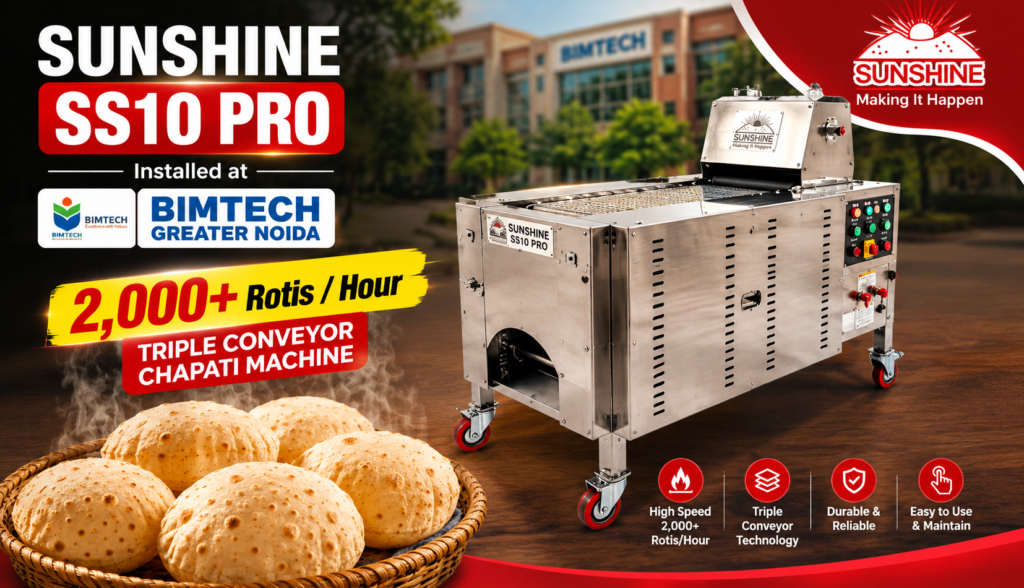
2,000+ rotis. Every hour. Zero compromise.
The Sunshine SS10 Pro Triple Conveyor Chapati Machine is now running inside Birla Institute of Management and Technology — bringing consistent, hygienic, high-volume roti production to one of Greater Noida’s largest institutional kitchens.
- 01 A new milestone at BIMTECH
- 02 Why institutions need automation
- 03 Introducing the SS10 Pro
- 04 2,000+ rotis/hour
- 05 Triple conveyor baking
- 06 Maintenance-free burners
- 07 Italian gearbox
- 08 Stainless-steel body
- 09 Up to 60% fuel savings
- 10 Consistency in every batch
- 11 Reducing manual pressure
- 12 Why BIMTECH matters
- 13 Built for institutions
- 14 What modern kitchens want
- 15 A smarter approach
- 16 Upgrade your kitchen
A new milestone in automated chapati production
We’re thrilled to announce the successful installation of the Sunshine Triple Conveyor Chapati Machine – SS10 Pro at the Birla Institute of Management and Technology (BIMTECH), Greater Noida.
This installation marks another important milestone in our journey of helping large institutions, educational campuses, hostels, canteens, hotels, hospitals, and commercial kitchens simplify their chapati production with reliable and efficient automation.
Serving fresh, hygienic, and consistently prepared rotis to hundreds or thousands of people every day is a demanding task. Traditional roti-making moves through multiple stages — dough preparation, portioning, rolling, baking, and handling — and at high volumes, holding the same quality, speed, hygiene, and consistency all day becomes harder still.
That’s where an advanced automatic roti making machine makes the difference. With the SS10 Pro now live at BIMTECH, the institution gains an automated system built for high-volume food service: 2,000+ rotis per hour, triple conveyor baking, maintenance-free burners, an Italian gearbox, a durable stainless-steel body, and fuel savings of up to 60%.
Why large institutions need automatic roti making machines
Food service in educational institutions doesn’t behave like household cooking. A large campus may need to feed students, faculty, staff, and visitors across multiple mealtimes every single day.
When hundreds or thousands of rotis have to be ready inside a limited window, manual production becomes hard to manage — it demands considerable manpower, constant supervision, and tight coordination between every stage of preparation.
An automatic chapati making machine addresses this directly. Instead of relying entirely on manual rolling and baking, commercial kitchens can lean on an automated system built for a consistent production flow — easing pressure on kitchen staff while meeting high-volume demand. For a campus like BIMTECH, where food service supports a large, active community, that production capacity and operational efficiency matter enormously.
Introducing the Sunshine SS10 Pro Triple Conveyor Chapati Machine
A high-capacity automatic chapati machine developed for commercial and institutional kitchens where speed, consistency, and operational efficiency matter.
Its signature feature is the triple conveyor baking system. In a conventional kitchen, baking large quantities of rotis takes significant manual effort. The SS10 Pro’s triple-conveyor configuration is built to support a continuous baking process — streamlining production and lifting throughput without extra hands on deck.
Paired with a capacity of 2,000+ rotis per hour, the machine suits large-scale food operations where hundreds or thousands of rotis need to be served within a single meal period — from institutions and hostels to industrial canteens, hotels, and hospitals.
2,000+ rotis per hour for high-volume requirements
For a large kitchen, time is an operational constraint. Meal preparation runs on a fixed schedule — breakfast, lunch, and dinner all have specific serving windows, and kitchen teams need food ready when it’s required.
A high-capacity automatic roti machine helps kitchens hold that schedule. Producing more than 2,000 rotis per hour means the SS10 Pro is built for environments where high-volume production isn’t occasional — it’s every day.
For an institution like BIMTECH, that capacity proves especially valuable during busy meal periods, when many students and staff need to be served inside a short window.
Rather than depending entirely on manual production, the kitchen integrates automated chapati production directly into its overall food preparation workflow — freeing staff to focus on quality, hygiene, and service.
Triple conveyor baking for efficient production
A conveyor-based system lets baking follow a continuous production flow. Instead of pushing each roti through separate manual baking steps, the automated system moves product through the baking process efficiently — end to end.
The triple conveyor configuration is especially useful in high-volume kitchens, where it supports continuous movement and baking at once. For a commercial kitchen, that continuity reduces unnecessary pauses between batches and creates a smoother workflow — particularly important during peak meal hours, when teams need high output without sacrificing operational efficiency.
Built with components that hold up to daily commercial use
Three engineering choices behind the SS10 Pro’s reliability — each solving a specific pain point in institutional kitchens.
Maintenance-free burners
Reduces the need for regular burner upkeep, so kitchen teams spend less time on maintenance and more time on food preparation and service — even across extended, high-usage production cycles.
Italian gearbox
A reliable drive system supports the smooth, continuous operation a high-production kitchen demands — engineered for regular commercial use, not just quick output.
Stainless-steel body
Durable and hygiene-forward by design, the stainless-steel body is built to withstand repeated daily operation while complementing a modern commercial kitchen’s cleanliness standards.
Up to 60% fuel savings
Fuel is one of the recurring operating expenses in any large-scale kitchen, and when equipment runs for several hours every day, efficiency gains compound into real cost control.
The SS10 Pro is engineered to deliver up to 60% fuel savings — a meaningful advantage for any kitchen producing thousands of rotis, and one that lets institutions hold production levels while working toward lower operating costs. Over time, even modest improvements in recurring expenses add up to a meaningful difference for a large institution.
Consistency in every batch
One of the biggest challenges of large-scale manual roti production is maintaining consistency. A roti needs to meet the kitchen’s expected standard — and when multiple people handle production by hand, variation in size, thickness, and bake naturally creeps in.
Automation brings greater uniformity to high-volume chapati production. That consistency isn’t only cosmetic — it builds a predictable kitchen workflow, letting teams plan requirements more effectively and coordinate chapati production alongside every other food preparation activity.
Reducing the pressure of manual production
Manual chapati preparation is physically demanding, especially at continuous, high volume. Rolling and baking thousands of rotis takes real effort and coordination — and leaning entirely on manual production puts added pressure on the workforce during peak meal hours.
The goal of automation here isn’t to replace the kitchen team — it’s to shift repetitive, high-volume tasks onto the machine, so human attention can go where it matters most: quality control, hygiene, and service.
Why the BIMTECH installation is significant
BIMTECH represents exactly the kind of institutional environment where food operations need to support a large, active community — and where equipment has to handle volume, hold consistency, and support smooth meal-time operations all at once.
Installing a 2,000+ roti-per-hour triple conveyor chapati machine is a real step toward modernizing chapati production and improving the efficiency of large-scale food preparation on campus. For Sunshine, every installation is more than placing a machine at a new site — it’s a chance to show how automation solves the operational challenges modern kitchens actually face.
Built for institutions and commercial kitchens
Wherever the requirement is many rotis in a limited time, the SS10 Pro offers a more streamlined approach.
Automation meets practical kitchen requirements
Modern commercial kitchens want more than automation for its own sake — they want a machine that combines all of the below at once.
The Sunshine SS10 Pro brings all five together through high output, triple conveyor baking, maintenance-free burners, an Italian gearbox, stainless-steel construction, and fuel-saving design.
A smarter approach to chapati production
The future of commercial food preparation is increasingly about efficiency, automation, and smarter resource management. As institutions and businesses grow, so do their food requirements — and preparing meals for large numbers of people takes careful planning, dependable equipment, and efficient processes.
A machine like the SS10 Pro turns a repetitive, labor-intensive process into an organized, continuous production workflow — 2,000+ rotis per hour, triple conveyor baking, maintenance-free burners, an Italian gearbox, stainless-steel construction, and up to 60% fuel savings, all in one system.
At Sunshine, our goal is to help commercial kitchens work smarter — and the BIMTECH installation is another step in that direction. Every installation gives us a closer look at what professional kitchens actually need, so we can keep delivering solutions built for real operational challenges.
Ready to upgrade your kitchen?
If your institution, hotel, hospital, canteen, catering business, or commercial kitchen needs high-volume chapati production, the Sunshine SS10 Pro can be a powerful addition to your operation.