
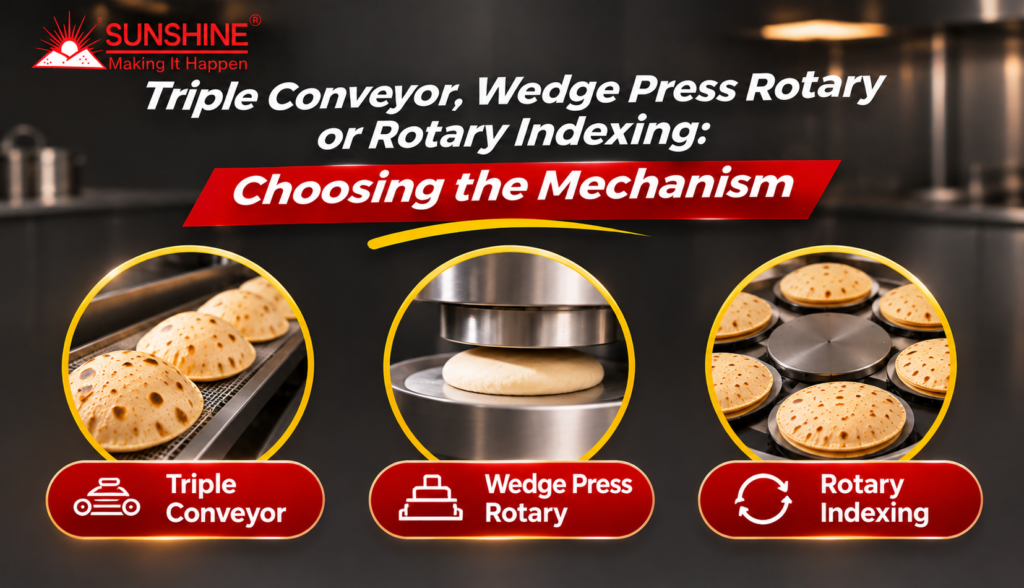
Two machines can produce the same thousand rotis an hour and be nothing alike inside. The mechanism decides footprint, how the machine behaves through a long service, and how it will feel to run every day for the next decade.
Most buyers start with a number: how many chapatis an hour. It is the right place to start and it narrows the field quickly — but it does not finish the job, because at almost any capacity you will find more than one way to get there.
Sunshine builds commercial chapati machines on three mechanisms. They overlap in output and differ in almost everything else. This page explains what each one actually does, and which kitchen each suits.
The three at a glance
| Mechanism | Models | Output | Best suited to |
|---|---|---|---|
| Triple conveyor | SS18, SS08, SS09 Slim, SS10 Slim | 300–2,000 chapatis/hr | Large hotels, industrial kitchens, high-volume caterers, production units |
| Wedge press rotary | SS17, SS11, SS12 | 300–1,000 chapatis/hr | Mid-sized kitchens, mess halls, institutional canteens, tight floor plans |
| Rotary indexing | SS02 | Around 1,000 chapatis/hr | Kitchens where uniformity across a long service matters most |
Notice the overlap. Between roughly 300 and 1,000 an hour all three are options, which is exactly the range most commercial kitchens sit in. So capacity alone will not choose for you.
Triple conveyor
Dough moves through pressing and baking on conveyor belts, in continuous flow. Nothing stops and restarts — pieces enter at one end and finished rotis come off the other while the next ones are already behind them.
That continuous flow is the whole point. It is what lets this mechanism reach 2,000 chapatis an hour, and it is why it holds a steady rate through a long service rather than depending on an operator’s rhythm. For a kitchen running continuously rather than in bursts, that matters more than peak figures.
Choose it when
- You need more than about 1,000 chapatis an hour — above that, this is the only option
- Production runs continuously rather than in short meal windows
- You are feeding a packing line or a dispatch schedule that cannot wait
- You have the floor length for a conveyor layout
What to plan for
A conveyor needs length. The slim models — SS09 Slim and SS10 Slim — are built for exactly this problem, giving conveyor throughput in a narrower body, and they are worth looking at even at moderate capacity if your kitchen is long and narrow rather than square.
Wedge press rotary
A rotary press using a wedge mechanism, covering 300 to 1,000 chapatis an hour. The defining characteristic is what it delivers per square foot: serious commercial output from a compact body.
For most kitchens, space is the binding constraint long before capacity is. A mess hall or canteen often has the demand for 700 chapatis an hour and nowhere near the floor area a conveyor layout wants. This mechanism exists for that situation, which is why it is the most common starting point for a first commercial machine.
Choose it when
- Floor space is your real constraint, not output
- You need up to about 1,000 chapatis an hour
- Service happens in defined meal windows rather than continuously
- You may need to reposition the machine within the kitchen later
What to plan for
The ceiling is around 1,000 an hour. If your honest twelve-month projection takes you past that, size up now rather than buying twice — our institutional sizing guide covers working out the real figure from headcount and serving window.
Rotary indexing
The SS02 rotates through balanced indices, so every chapati gets the same heat exposure for the same time at the same position. Around 1,000 an hour.
This one is chosen for a different reason from the other two. It is not about maximum speed or minimum footprint — it is about uniformity. Where a conveyor can develop small differences across its width, and where output on any mechanism can drift as a service wears on, balanced indexing holds every piece to the same treatment.
Choose it when
- Consistency across thousands of pieces matters more than peak speed
- You are supplying against a specification — a contract, a buyer, a packed product
- Services run long, and quality at the end must match quality at the start
- You want predictable output regardless of who is operating
What to plan for
Around 1,000 an hour is the working figure. For higher volume with the same consistency priority, the conversation moves to a triple conveyor or a fully automatic machine.
Three questions that usually decide it
How much floor space, in length and width? Not area — shape. A long narrow kitchen and a square one of the same size suit different mechanisms. Is production continuous or in bursts? Continuous favours conveyor; defined meal windows do not require it. Are you supplying against a specification? If a buyer audits your output, uniformity moves up the list.
Choosing between them
| If your priority is | Look first at | Why |
|---|---|---|
| Highest possible output | Triple conveyor | Only mechanism reaching 2,000 chapatis an hour |
| Smallest footprint for the output | Wedge press rotary | Compact body, up to 1,000 an hour |
| Most uniform output | Rotary indexing | Balanced indices give every piece identical heat exposure |
| Continuous all-day running | Triple conveyor | Built for continuous flow rather than batch service |
| A narrow kitchen | Slim triple conveyor (SS09, SS10) | Conveyor throughput in a narrower body |
| A first commercial machine | Wedge press rotary | Lowest space and capital commitment for real commercial output |
What is the same across all three
The mechanism changes how rotis are pressed and baked. It does not change the things that determine whether a machine lasts and whether a kitchen enjoys running it.
- Food-grade stainless steel throughout
- No hidden enclosures, so flour and dough cannot collect out of reach and daily cleaning is quick
- No dry dusting flour needed at pressing or baking
- Chapati diameter and thickness adjustable to your requirement
- Minimal hand contact through the process
- Operable after short training by staff with no prior machine experience
- Spare parts stocked in India, with service across our network
All three also pair with the same dough-side equipment — a kneading machine and a dough ball cutting machine — so the mechanism decision does not lock you into a particular line later.
Mechanism is not the same question as automation level
Worth separating, because the two get confused. The mechanism is how pressing and baking happen. The automation level is how many stages the machine covers — whether you hand it dough balls, or kneaded dough and it divides them itself.
You decide both, and they are independent. Our comparison of semi automatic versus fully automatic covers the second question, and which chapati machine does what sets out the four production stages.
See it running before you decide
Specifications narrow the choice; watching a machine work settles it. We run demonstrations at our Noida facility, can share video of a specific model under load, and where possible can arrange for you to see one in a working kitchen similar to yours.
Twenty-five years of building these has mostly taught us that buyers choose well when they can see the difference rather than read about it. Tell us your requirement and we will show you the one we think fits — and say so if it is not the one you came in asking about.
Frequently asked questions
What is the difference between a triple conveyor and a rotary chapati machine?
A triple conveyor moves dough through pressing and baking on belts in continuous flow, which is what lets it reach 2,000 chapatis an hour and hold a steady rate through long services. A rotary mechanism presses in a rotating cycle within a far more compact body, covering up to about 1,000 an hour. Conveyor suits continuous production; rotary suits tight floor plans.
Which chapati machine mechanism is best for a small kitchen?
Wedge press rotary — models SS17, SS11 and SS12. It delivers 300 to 1,000 chapatis an hour from a compact body, which is why it is the usual starting point when floor space rather than output is the binding constraint. If your kitchen is long and narrow rather than small overall, the slim triple conveyor models are also worth considering.
What is rotary indexing and when should I choose it?
The SS02 rotates through balanced indices so every chapati receives the same heat exposure for the same time at the same position. Choose it when uniformity across thousands of pieces matters more than peak speed — supplying against a buyer specification, running long services where the last roti must match the first, or wanting predictable output regardless of operator.
Can I get 2,000 chapatis an hour from a rotary machine?
No. Wedge press rotary tops out around 1,000 an hour and rotary indexing works at around 1,000. Above that the triple conveyor models — SS18, SS08, SS09 Slim and SS10 Slim — are the only option, because continuous belt flow is what makes that rate possible.
Does the mechanism affect cleaning, build quality or running the machine?
No. All three are built in food-grade stainless steel throughout, with no hidden enclosures where flour can collect, no dry dusting flour needed at pressing or baking, adjustable chapati diameter and thickness, and operation that staff can learn in a short training session. The mechanism changes how pressing and baking happen, not how the machine is built or maintained.
Not sure which mechanism fits?
Send us your peak-hour requirement and your available floor space — length and width, not just area. We’ll tell you which of the three suits you, and show you that model running under load.
Contact: +91-9818172990 | +91-0120-4337946 | info@sunshineindustries.co.in