
Numbers are Convincing. Real Installations are proof.
It is one thing to talk about chapati machines producing 1,000, 1,500, or 2,000 rotis an hour. It is another thing entirely to walk into a working kitchen and see it happening. Trays of soft, uniform, perfectly cooked chapatis coming off the line, one after another, without a single cook standing exhausted over a Tava.
That is exactly what is happening right now across some of India’s most demanding kitchens, from spiritual institutions serving thousands of devotees, to five-star luxury resorts hosting India’s biggest weddings, to university campuses feeding thousands of students every single day.
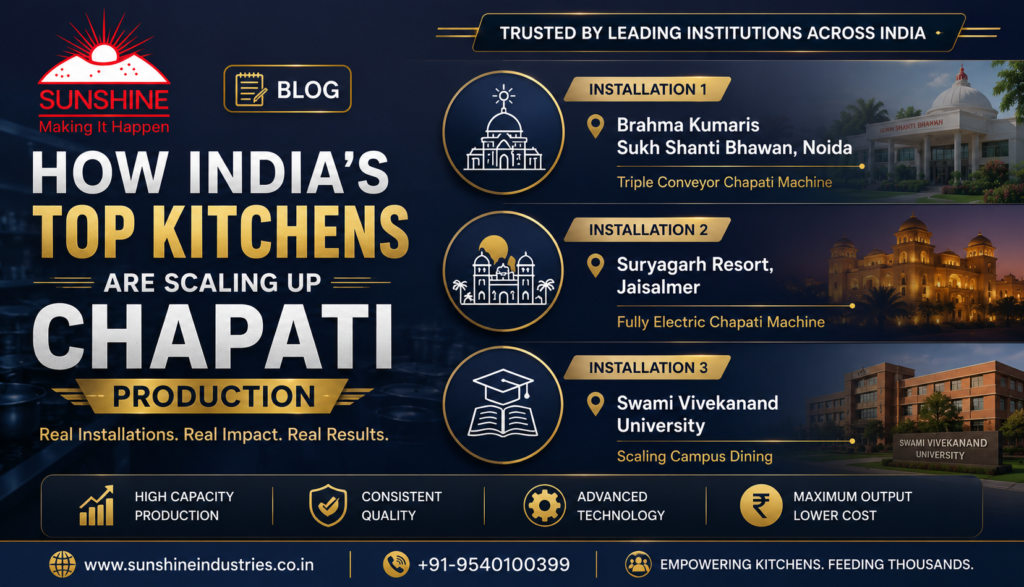
Over the past few months, Sunshine Industries has installed machines in three remarkably different settings, each with its own scale, its own pressures, and its own reason for choosing automation. Here is what that looks like in practice.
Installation 1: Brahma Kumaris Sukh Shanti Bhawan, Noida — Triple Conveyor Chapati Machine
The Challenge
Spiritual institutions like Brahma Kumaris centres are not ordinary kitchens. Sukh Shanti Bhawan in Noida serves large numbers of devotees, visitors, and residents daily, and during festivals, special gatherings, and spiritual events, that number multiplies significantly.
Feeding a community at this scale with consistency, purity, and hygiene is not just an operational requirement, for an institution rooted in spiritual values; it is a matter of principle. Food prepared and served at these centres needs to reflect the same care and discipline that defines everything else about the institution.
Manual chapati production at this scale presents real challenges. Even with a dedicated team of cooks, producing hundreds of fresh, soft, identically cooked rotis multiple times a day, every day, without fail, places enormous pressure on kitchen staff. During larger gatherings, pressure multiplies fast.
The Solution
Sunshine Industries recently completed the installation of a brand-new Triple Conveyor Chapati Machine at Brahma Kumaris Sukh Shanti Bhawan, Noida.
The Triple Conveyor system is one of Sunshine’s most capable commercial configurations, using a continuous conveyor belt mechanism for pressing and baking that delivers uninterrupted, high-volume output. Depending on demand, this configuration is capable of producing between 1,000 and 2,000 chapatis per hour, with completely consistent thickness, size, and cooking quality across every single roti.
For an institution where food is prepared as an offering of seva, selfless service, consistency, and purity are not just operational metrics. They matter spiritually. A machine that produces the same soft, well-cooked chapati every single time, without variation caused by fatigue or rushed hands, fits naturally into that ethos of disciplined, mindful service.
The Impact
With the Triple Conveyor machine now operational, the kitchen team at Sukh Shanti Bhawan can comfortably scale chapati production up or down based on the size of the gathering on any given day, without the unpredictability that comes from depending entirely on how many skilled cooks are available or how tired they are by the third hour of continuous service.
This is exactly the kind of installation that captures why Sunshine machines resonate so strongly with institutional and spiritual kitchens across India, from temple langars to community centres. The mission is service. The machine simply makes that mission easier to deliver, day after day, at any scale required.
Installation 2: Suryagarh Resort, Jaisalmer — Fully Electric Chapati Machine
The Challenge
Few hospitality settings in India carry the prestige of Suryagarh Resort in Jaisalmer, widely regarded as one of the most luxurious wedding destinations in the country. Set against the dramatic backdrop of the Thar Desert, Suryagarh hosts grand Indian weddings, destination celebrations, and high-profile guests who expect nothing short of flawless execution at every single touchpoint.
In a resort to this caliber, food is not simply a logistical necessity; it is part of the guest’s experience itself. When a wedding party of several hundred guests sits down for a meal, every plate needs to arrive with the same standard of quality, presentation, and warmth, regardless of whether it is the first table served or the last.
Traditional manual chapati production simply cannot guarantee that level of consistency at scale, especially during multi-day wedding functions where the kitchen is under sustained, high-volume pressure for days at a stretch.
The Solution
Sunshine Industries recently installed a brand new Fully Electric Chapati Machine at Suryagarh Resort: one of the newest additions to Sunshine’s product range, and a significant step forward in commercial roti-making technology.
Unlike traditional gas-powered commercial machines, the Fully Electric model offers a cleaner, more controlled cooking process with precise, consistent heating, ideal for a luxury hospitality environment where both operational efficiency and kitchen safety standards are exceptionally high. Electric operation also means more predictable energy costs and a quieter, lower-emission kitchen environment; both increasingly important considerations for premium resorts focused on sustainability.
For a destination wedding venue like Suryagarh, where the kitchen may need to produce chapatis continuously across multiple meal services in a single day during peak wedding season, the Fully Electric Chapati Machine delivers the reliability and consistency that match the resort’s own standard of excellence.
The Impact
With this installation, Suryagarh’s kitchen team gains the ability to handle the demanding, high-volume requirements of large wedding functions without compromising on the quality guests have come to expect from one of India’s most celebrated luxury properties. Every chapati served, whether to a wedding party of 50 or a celebration of 500, now reflects the same soft texture, even cooking, and consistent quality.
This is precisely the kind of installation that demonstrates Sunshine’s machines are not only built for high-volume institutional kitchens but are equally suited to the exacting standards of premium hospitality, where consistency is not just operationally important, but central to the entire guest experience.
Installation 3: Swami Vivekanand University — Scaling Campus Dining
The Challenge
University campuses present one of the most demanding chapati production environments in the country. Thousands of students need to be fed within tight meal windows, breakfast, lunch, and dinner, every single day, seven days a week, throughout the academic year.
Unlike a restaurant where demand fluctuates, a university mess hall faces relentless, predictable, high-volume demand at the same time every day. Manual production at this scale typically requires a large dedicated kitchen staff working in shifts, with all the recruitment, training, and consistency challenges that come with managing a sizeable team focused purely on chapati production.
For an institution like Swami Vivekanand University, ensuring that every student receives fresh, hygienic, properly cooked food, without long queues or delays during peak meal hours: is central to maintaining the quality of campus life.
The Solution
Sunshine Industries recently completed an installation at Swami Vivekanand University, equipping the campus kitchen with an automatic chapati making machine sized for sustained, high-volume daily production.
For institutional kitchens like university messes, the priority is rarely about producing the absolute highest possible output in a single hour, it is about reliable, repeatable, hygienic production across every single meal service, day after day, without depending on the unpredictability of a large rotating kitchen staff.
The Impact
With automated chapati production now part of the university’s kitchen operations, the campus dining team can serve students more efficiently during peak meal windows, reduce dependency on a large manual chapati workforce, and maintain consistent food quality across every meal service, breakfast, lunch, and dinner, throughout the academic term.
For an educational institution managing the daily reality of feeding a large, diverse student population, this kind of operational reliability translates directly into a better, smoother campus dining experience.
What These Three Installations Have in Common
At first glance, a spiritual centre in Noida, a luxury wedding resort in the Thar Desert, and a university campus could not seem more different. But look closer, and the same underlying story repeats across all three:
Scale that manual labour alone could not reliably sustain: Whether it is hundreds of devotees, hundreds of wedding guests, or thousands of students, each of these kitchens reached a point where dependable, high-volume chapati production needed something more consistent than relying entirely on the availability and stamina of skilled human cooks.
Consistency that matters to the mission: A spiritual institution values purity and discipline in food preparation. A luxury resort valued flawless guest experience. A university values dependable daily service to its students. In every case, consistent quality was not a nice-to-have — it was central to what the institution stands for.
The right machine for the right context: Sukh Shanti Bhawan needed the high-volume capability of a Triple Conveyor system. Suryagarh needed the precision and clean operation of a Fully Electric machine suited to a premium hospitality environment. Swami Vivekanand University needed dependable, sustained daily output across a demanding mess hall schedule. Sunshine range of 20+ machine models exist precisely because no single configuration fits every kitchen, and these three installations show that range in action.
Why These Installations Matter Beyond the Numbers
It would be easy to reduce these stories by throughput numbers, chapatis per hour, capacity figures, and output multiples. And those numbers matter. But the real story in each of these installations is what automation freed these kitchens to focus on instead.
At Sukh Shanti Bhawan, kitchen staff can now devote more attention to the broader spiritual and community responsibilities of running a centre that serves so many people, rather than being consumed entirely by the physical demands of chapati production.
At Suryagarh, the culinary team can focus their expertise on the other elements of a world-class wedding banquet, knowing the chapati component of every meal will arrive with guaranteed, flawless consistency, freeing them to elevate everything else on the menu.
At Swami Vivekanand University, the dining services team can focus on improving the broader student dining experience, variety, nutrition, and service speed, rather than constantly managing the staffing and training challenges that come with a large manual chapati production team.
In every case, the machine did not just produce more rotis. It gave these institutions back the time, attention, and operational bandwidth to focus on what actually matters most to their mission.
The Bigger Pattern: India’s Kitchens Are Rethinking Scale
These three installations are not isolated events. They reflect a much larger shift happening across Indian commercial and institutional kitchens right now.
For decades, the assumption was simple: if you need more chapatis, you hire more cooks. That logic worked when kitchens were smaller, demand was more predictable, and skilled labor was easier to find and retain. None of those conditions hold as reliably today. Skilled chapati cooks are harder to recruit in most Indian cities. Labor costs, including the full picture of salary, food, leave, and statutory contributions, have risen steadily. And the scale at which modern institutions operate, whether a university feeding thousands, a resort hosting a multi-day wedding, or a spiritual center serving a growing community, has simply outpaced what manual production can comfortably sustain.
What we are seeing in installations like Sukh Shanti Bhawan, Suryagarh, and Swami Vivekanand University is the natural response to that shift. These are not businesses cutting corners or reducing their standards. If anything, the opposite is true; each of these institutions chose automation specifically because it allowed them to raise their standards of consistency, hygiene, and reliability beyond what manual production alone could guarantee.
This pattern is showing up across nearly every category of large-scale food service in India: temples and community kitchens that have relied on automated langar systems for years, hospitals and healthcare facilities where consistency has clinical importance, corporate campuses feeding thousands of employees within tight lunch windows, and now, increasingly, premium hospitality properties and educational institutions recognising the same operational logic.
The common realisation across all of them is the same: at a certain scale, consistency and reliability are not things you can fully guarantee through manual effort alone, no matter how skilled or dedicated your kitchen staff are. A well-built machine removes that uncertainty entirely.
Is Your Kitchen Facing a Similar Scale Challenge?
Whether you are running a spiritual or community institution serving large numbers of devotees, a hospitality property hosting events that demand flawless consistency, or an educational institution feeding thousands of students every single day, the operational pressures behind each of these installations are more common than most kitchen owners realise.
Sunshine Industries has spent over 25 years building machines for exactly these situations. With 5,000+ installations across more than 15 countries and a product range spanning compact semi-automatic units to fully automatic, high-capacity Triple Conveyor and Fully Electric systems, there is a configuration built for almost every kitchen scale and context.
These three installations, a spiritual centre, a luxury resort, and a university campus, are a small sample of the diversity of kitchens Sunshine Industries serves every month across India. The common thread is always the same: a kitchen that reached the limits of what manual production could reliably deliver, and found a machine built specifically for the scale and standard they needed to meet.
Ready to see what an automatic chapati machine could do for your kitchen?
📞 +91-9818172990 🌐 sunshineindustries.co.in
Sunshine Industries — 25+ years of experience, 5,000+ installations across 15+ countries, and 20+ machine models built for every kitchen, from community centres to luxury resorts to university campuses.