
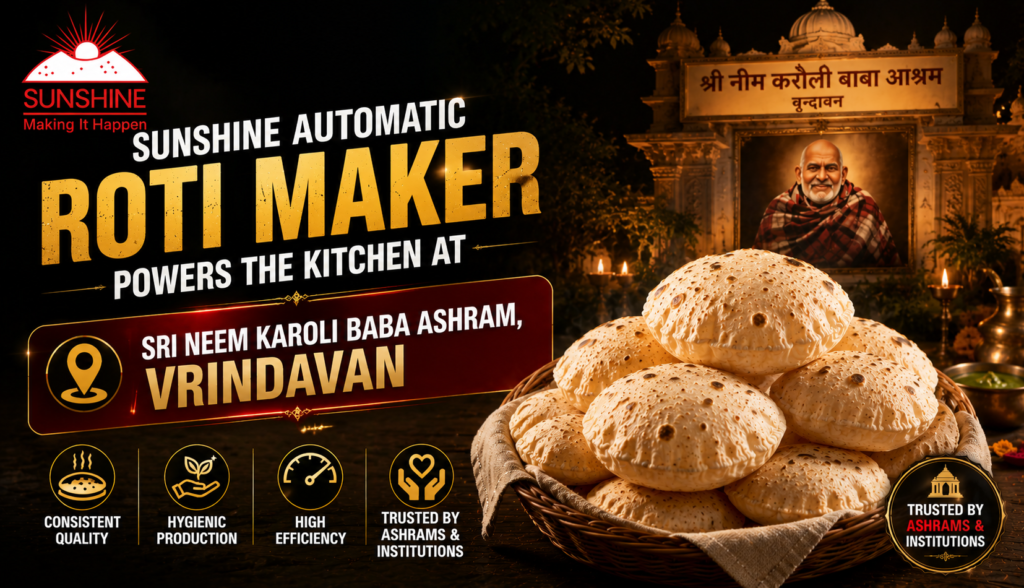
A Machine That Understands the Weight of Feeding Thousands
Some kitchens don’t just cook food — they carry responsibility. At Sri Neem Karoli Baba Ashram in Vrindavan, thousands of devotees arrive every single day, and every single one of them is served prasad with the same care, the same warmth, and the same respect. Behind that simple bowl of dal and stack of soft, hot rotis is a kitchen that runs almost like a small factory, working from early morning to late evening, day after day, without a break.
This is exactly the kind of place where we’re proud to say Sunshine has stepped in — with our automatic roti maker setup now running at the ashram, helping the kitchen team serve more people, more consistently, and with far less physical strain than before.
In this blog, we’ll walk you through why an ashram like this needs automation in the first place, what changed after the Sunshine setup was installed, and why this story matters for anyone running a large kitchen — whether it’s a temple, an ashram, a hostel, or a big event caterer.
The Real Challenge Behind Ashram Kitchens
If you’ve never worked in a large community kitchen, it’s easy to underestimate just how hard the work is. Making rotis by hand for a few people is simple. Making rotis by hand for hundreds — sometimes thousands — of people, every day, without fail, is a completely different challenge.
A few things make ashram and temple kitchens especially demanding:
- The numbers are huge and unpredictable. On a normal day, the kitchen might serve a certain number of devotees. On a festival day or a special occasion, that number can jump many times over, with almost no warning.
- The food has to be ready on time, every time. There’s no room for delay when hundreds of people are waiting in line, often after a long journey or a long day of prayer and darshan.
- Consistency matters deeply. Every roti served as prasad should feel the same — soft, warm, and made with care — whether it’s the first one of the day or the last.
- The kitchen staff work incredibly hard, often for many hours at a stretch. Rolling and cooking rotis by hand, hour after hour, takes a real physical toll on the people doing this seva.
This is the exact situation where a manual approach, no matter how devoted the kitchen staff are, starts to reach its limits. It’s not about replacing the spirit of seva — it’s about supporting the people doing it, so they can serve more, with less exhaustion.
Why Sunshine Was the Right Fit
When the ashram’s kitchen team started looking for a solution, they weren’t just looking for “a machine.” They were looking for something that could match the scale, the rhythm, and the seriousness of what they do every single day — and do it in a way that respected the tradition and cleanliness expected in a place of worship.
Here’s what made the Sunshine automatic roti maker setup the right choice:
- High, steady output. The machine is built to produce a large number of rotis every hour, without slowing down as the day goes on — something that’s simply not possible with hand-rolling alone once volumes get large.
- Consistent quality. Every roti that comes off the machine goes through the same process — same thickness, same baking, same softness — so there’s no difference between the 10th roti and the 1,000th.
- Hygienic, low-touch process. In a place where cleanliness and purity of food matter as much as taste, an automated process that reduces manual handling is a genuine advantage.
- Built for continuous, long-hour use. Ashram kitchens don’t run for an hour and stop — they run for most of the day. The setup was chosen specifically because it’s designed to handle that kind of sustained, heavy-duty use.
- Simple enough for the kitchen team to operate confidently. A machine is only useful if the people running it can use it smoothly every day, so ease of operation was just as important as raw output.
What Changed After Installation
Since the Sunshine setup was installed at the ashram, the difference has been felt most by the people actually working in the kitchen. Tasks that used to take a large team of people rolling and cooking by hand for hours can now be handled with far fewer people standing at a hot stove for hours on end. That doesn’t mean less seva — it means the same devotion, redirected toward serving more people with less physical strain.
The kitchen is now able to keep up more comfortably with sudden spikes in footfall, such as festival days or special occasions, without the stress of falling behind. And because the machine produces rotis at a consistent quality, the kitchen team can focus their attention on other parts of the meal — the sabzi, the dal, the serving process — rather than being fully consumed by roti-making alone.
A Day Inside an Ashram Kitchen, Before and After
To really understand why this setup matters, it helps to picture what a typical day looked like before automation, and what it looks like now.
Before, the kitchen team would begin roti preparation many hours before the first meal service, because hand-rolling and cooking at scale simply takes that much time. A large team would be needed at the stove for most of the day, taking turns, managing heat, and trying to keep the pace steady even as hands grew tired and the hours grew long. On busy days — festivals, special pujas, or large gatherings — the team would often be stretched to its absolute limit, sometimes struggling to keep rotis coming out fast enough to match the line of devotees waiting to be served.
Now, with the Sunshine setup running, the same volume of rotis can be produced in a fraction of the time, with far fewer people needed to stand over open flames for hours at a stretch. The kitchen team can start later, finish earlier, and spend more of their energy on the parts of meal preparation that genuinely need a human hand — the sabzi, the dal, the seasoning, and the care that goes into serving each person. It’s not a loss of tradition; it’s the tradition being supported by better tools, the same way a temple might use modern sound systems for aarti without it changing the meaning of the prayer.
Seva and Technology Aren’t in Conflict
There’s sometimes a hesitation around bringing machines into spiritual spaces, as if efficiency and devotion are somehow opposites. But if you spend time in a kitchen like this one, you quickly see that the opposite is true. The seva isn’t in the repetitive motion of rolling dough for the thousandth time that day — the seva is in the intention behind feeding someone, in making sure no one leaves hungry, and in doing that with consistency and respect, day after day, year after year.
A machine that removes physical strain and repetitive labor doesn’t take away from that intention. If anything, it protects it — because exhausted, overworked hands are far more likely to lead to inconsistency, delays, or simply not being able to serve everyone who’s come. Technology, used thoughtfully, becomes one more way of honoring the commitment behind the kitchen’s work, not a replacement for it.
Behind the Scenes: What the Installation Looked Like
Setting up an automatic roti maker inside an active, high-volume kitchen isn’t as simple as plugging in a new appliance. The process typically involves understanding the kitchen’s daily rhythm — peak hours, average footfall, festival-day spikes — and configuring the machine and its placement to fit smoothly into that flow, without disrupting the kitchen’s existing routine any more than necessary.
For a space like this ashram, the setup also had to respect the kitchen’s layout, cleanliness protocols, and the team’s existing way of working. The goal was never to force the kitchen to adapt entirely around the machine, but to fit the machine into the kitchen’s existing rhythm — training the team on operation, working through the first few busy days together, and fine-tuning until the process felt natural rather than forced.
Why This Story Matters Beyond Vrindavan
We’re sharing this story not just because we’re proud of it (though we genuinely are), but because it’s a real example of something a lot of kitchen managers, temple trusts, and catering businesses are quietly wondering about: can automation actually work in a large, traditional, high-volume kitchen without losing what makes that kitchen special?
The answer, based on what we’ve seen at this ashram, is yes. The soul of the kitchen — the intention, the care, the seva — doesn’t come from rolling each roti by hand. It comes from the people running the kitchen and the purpose behind the food. A machine like the Sunshine automatic roti maker simply removes the physical bottleneck, so that purpose can reach more people, more reliably.
If your kitchen serves a large number of people every day — whether it’s a temple, an ashram, a school, a hospital, a hostel, or a catering business — this is exactly the kind of setup worth looking into.
A Few Common Questions
Does an automatic roti maker change the taste or quality of the rotis? No — if anything, it makes quality more consistent. Every roti goes through the same process, so there’s no variation caused by tiredness, different hands, or long shifts, which can naturally happen with manual rolling over many hours.
Is this kind of setup only for very large kitchens? Large-volume kitchens see the biggest benefit, but the same core idea — consistent quality with less manual labor — applies to any kitchen that regularly struggles to keep up with demand during busy hours.
How much space does a setup like this usually need? This depends on the specific machine model and daily output required. It’s best to share your kitchen’s approximate space and daily serving numbers so the right configuration can be recommended.
Bringing This to Your Kitchen
Whether you run a temple kitchen, an ashram, a large hostel mess, a hospital canteen, or a catering business that serves big numbers every day, the challenge is often the same: how do you keep up with demand without burning out your kitchen staff or compromising on quality?
If that sounds familiar, we’d love to talk. Reach out to us to understand which Sunshine automatic roti maker setup fits the scale of your kitchen.
📞 +91 95401 00399
🌐 www.sunshineindustries.co.in