
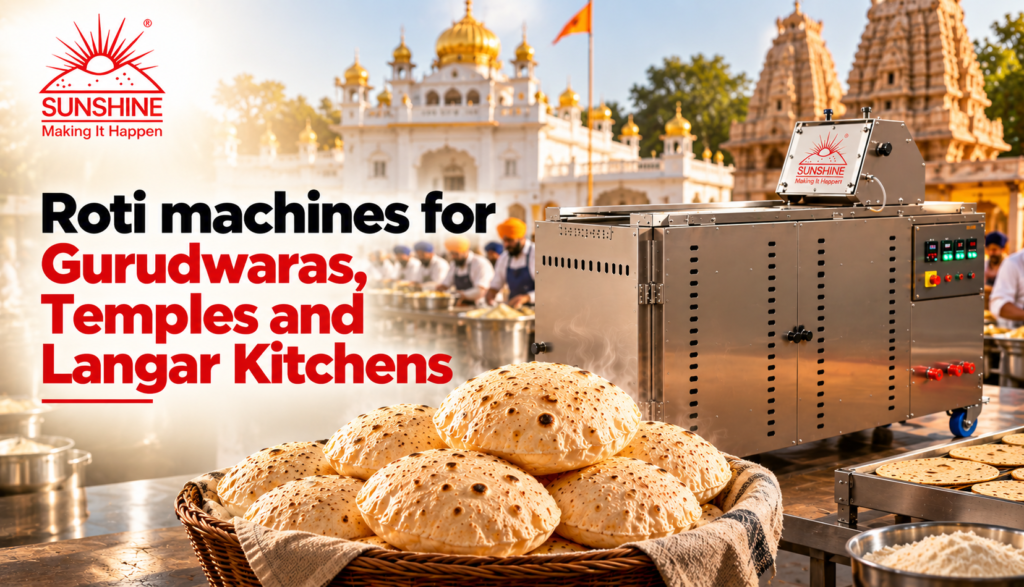
A community kitchen has a requirement no restaurant does: it must never turn anyone away, and it can’t predict how many will come. That single fact changes how you should choose a machine.
Target keyword: roti machine for gurudwara / langar / temple kitchen
Suggested slug: /roti-machine-for-gurudwara-temple-langar-kitchen/
Meta title: Roti Making Machines for Gurudwaras, Temples and Langar Kitchens | Sunshine Industries
Meta description: Choosing a chapati machine for a langar, bhandara or temple kitchen — sizing for unpredictable crowds, sewadar operation, festival peaks and hygiene at community scale.
In a restaurant, demand is roughly knowable. In a langar hall or temple bhandara, a normal Tuesday and a festival day can differ by a factor of ten, and the kitchen is expected to serve everyone who arrives either way. Equipment chosen on average demand fails on the days that matter most.
This guide covers what’s actually different about specifying a roti machine for a community kitchen, and what we’ve learned supplying them.
Five requirements specific to community kitchens
- Capacity sized to festival peaks, not daily average A gurudwara serving 300 people on an ordinary day may serve several thousand on a gurpurab. The machine has to hold up on that day. This usually means specifying a capacity that looks oversized against the daily number — and that’s correct, not wasteful.
- Operable by rotating volunteers In most langars, sewadars change daily and many have never used the machine before. A machine that requires a trained operator is the wrong machine here. Controls need to be simple enough that someone can be shown once and left to run the line.
- Sustained running for hours Community kitchens don’t serve in a ninety-minute window and stop. Service often runs continuously through the day, and on festival days for many hours without a break. The machine must be rated for continuous duty, not intermittent bursts.
- Hygiene at scale, with many hands involved Large volunteer teams and high throughput make hand contact the biggest hygiene risk. A machine that removes most of the handling — and that has no hidden cavities where atta collects — matters more here than almost anywhere else.
- Long service life and repairability This is usually a donated or committee-approved purchase, and it needs to last. Food-grade stainless steel construction, spare parts stocked in India, and a technician who can be reached are not optional considerations.
Sizing for a community kitchen
The method is different from a commercial kitchen. Instead of your busiest hour, start with your largest expected gathering.
- Take your biggest single-day attendance across the year — a festival, a major function, an anniversary.
- Multiply by rotis per person for your seva (commonly 2 to 4).
- Divide by the number of hours you realistically serve on that day.
- Add headroom, because attendance on those days tends to exceed expectation.
The number you get is your machine capacity. On ordinary days you’ll run well below it, which is fine — a machine running at half load simply lasts longer.
| Kitchen scale | Suggested configuration |
| Small temple or local gurudwara up to ~500 rotis/hr on peak | Wedge press rotary model (SS17, SS11, SS12) with a dough kneading machine. Compact and simple to run. |
| Mid-size community kitchen 500–1,000 rotis/hr on peak | Rotary indexing (SS02) for consistency across a long service, or a triple conveyor model. Add a peda cutter to reduce the volunteer workload. |
| Large langar, ashram or pilgrimage kitchen 1,000–2,000+ rotis/hr | Triple conveyor (SS18, SS08, SS09 Slim, SS10 Slim) or a fully automatic machine that handles dividing, pressing and baking in one unit. |
Two machines can beat one big one
For kitchens where service absolutely cannot stop, two mid-capacity machines are often a better specification than one large one. You get the same peak output, you can run just one on ordinary days, and if one needs service the langar continues. Worth raising with your committee when the capital decision is being made.
The dough stage matters more here
Community kitchens produce dough in very large batches, often with volunteers who knead differently from one another. That variation shows up directly in the rotis. A dough kneading machine removes the variable and takes the heaviest physical work off the sewadars — which, in kitchens where volunteers are often elderly, is a real benefit beyond consistency.
A peda cutting machine is worth considering at higher volumes too. Hand-rolling pedas is where volunteer hours go in an automated langar, and it’s the last continuous manual step. How these fit together is explained in which chapati machine does what.
Gas, power and installation
Sunshine machines bake on gas burners and use electricity for pressing and motors, which keeps fuel cost per roti low — meaningful when you’re making tens of thousands of rotis a month at no charge to those eating them. Before installation, check three things: that your gas supply can sustain the burner load through a full service, that the electrical point is rated for the motors, and that you have clearance around the machine for cleaning access.
Our team handles installation and trains your kitchen team on site. We’d suggest training more than one sewadar, so the knowledge doesn’t sit with one person.
Seen in practice
We installed an automatic roti maker at Sri Neem Karoli Baba Ashram in Vrindavan, where thousands of devotees arrive every day. The full account is in our Vrindavan ashram case study, and there are more examples in our customer success stories.
Frequently asked questions
What capacity roti machine does a gurudwara langar need?
Size to your largest expected gathering rather than your daily average. Take peak-day attendance, multiply by rotis per person, divide by the hours you serve on that day, and add headroom. Community kitchens that size to average demand struggle on exactly the days that matter most.
Can volunteers operate the machine without training?
A short demonstration is needed, but our machines are built so that someone with no prior experience can run them after being shown once. We train your kitchen team at installation, and we’d recommend training several people rather than one, given that sewadars rotate.
Can the machine run continuously for several hours?
Yes. These are commercial machines rated for continuous duty — built in food-grade stainless steel with motors and burners specified for sustained running, unlike domestic roti makers which need cool-down periods.
Is one large machine better than two smaller ones for a langar?
For kitchens where service cannot stop, two mid-capacity machines often work better. Same peak output, lower running load on ordinary days, and continuity if one needs service. For kitchens with space constraints or a single peak window, one larger machine is simpler.
What maintenance does a community kitchen machine need?
Daily cleaning — straightforward, since the machines are designed without hidden enclosures where atta can collect — plus periodic checks on wear parts and an annual service. Our maintenance guide sets out the schedule.
Planning a langar or bhandara kitchen?
Tell us your peak-day attendance and how long service runs. We’ll recommend a configuration and can arrange a visit to a community kitchen already running our machines.
Contact: +91-9818172990 | +91-0120-4337946 | info@sunshineindustries.co.in