
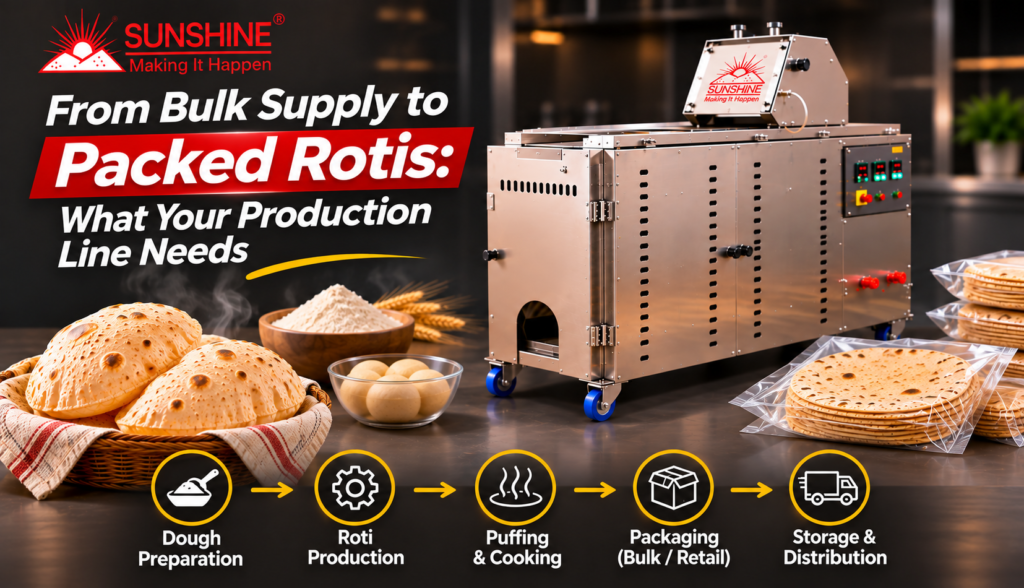
Supplying a canteen and supplying a shelf are the same product made to very different standards. The packaging is the part most people think about. The part that decides whether it works is whether every roti comes out identical.
Plenty of chapati producers reach the same point. Bulk supply to canteens and caterers is working, margins are thin but steady, and the obvious next step is selling rotis in a printed pack through stores or quick commerce — where the margin is considerably better.
The packaging side of that is a real project, and it is not ours: pouches, sealing equipment, cold chain and labelling compliance are specialist territory, and you will want a food technologist and a packaging supplier involved. What we can tell you about is the part we do build — the production line behind it, and what has to change before packed product is realistic.
What actually changes
A canteen accepts rotis that vary a little. One slightly thicker, one slightly smaller, and nobody raises it. A packed product cannot work that way, for four practical reasons.
| Requirement | Why it bites |
|---|---|
| Declared net weight | Every pack carries a weight on the label. If rotis vary, you either over-fill every pack and give away product on every unit sold, or you risk under-declaring. At scale the first is expensive and the second is not an option |
| Pack fit | Diameter and thickness have to suit the pouch and the stated count. Variation jams a packing line and looks obviously wrong through a transparent pack |
| Buyer specification | Retail and quick-commerce buyers specify, audit and reject against that specification. A supplier who cannot hold it loses the listing |
| Consistent ageing | Thicker and thinner rotis in the same pack hold moisture differently, so inconsistency affects how the whole pack performs over its shelf life |
This is the point where machine production stops being a convenience and becomes the requirement. Machine-made chapatis come out at a consistent weight — typically 25 to 50 grams depending on setting — with consistent diameter and thickness, piece after piece. Hand production cannot hold that across thousands of units a day, no matter how skilled the team.
Sizing the machine from your pack target
Work backwards. The number you start from is packs per day, not rotis per hour.
- Packs per day × pieces per pack
That gives your daily roti requirement. Use your realistic target for the first year, not your ambition for year three. - Divide by your production window
Not twenty-four hours. The hours you can actually run — one shift, two, with staff available and cooling and packing keeping pace. - Add headroom for the line, not just the machine
A production line runs at the speed of its slowest stage. If packing is slower than the machine, the machine waits. Size with that in mind rather than to the machine’s rated output. - Match to a model
Sunshine machines run from 300 to 2,000 chapatis an hour across triple conveyor, wedge press rotary and rotary indexing mechanisms. Which suits you depends on your figure, your floor space and whether production is continuous or batched.
| Scale | Rough requirement | Typical configuration |
|---|---|---|
| Local packed supply, early stage | Up to ~700 rotis/hr | Wedge press rotary with a dough kneader |
| Established packed brand | 700–1,200 rotis/hr | Triple conveyor, with a peda cutter feeding it |
| Production unit supplying retail at scale | 1,200–2,000+ rotis/hr | Slim triple conveyor or a fully automatic machine integrating dividing, pressing and baking |
Why the peda cutter stops being optional
For bulk supply, a dough ball cutting machine is a sensible upgrade you can add when volume justifies it. For packed product it is close to essential, and the reason is the declared weight on your label.
A chapati’s finished weight is set by its peda. Hand-rolled dough balls vary, so finished rotis vary, so pack weight varies — and you end up over-filling to stay safe. Machine-cut pedas come out the same every time, which is what lets you fill to a declared weight without giving product away on every pack.
Over a year of retail volume, that margin difference usually exceeds the cost of the machine comfortably.
Dough becomes a written specification
In a canteen kitchen, dough is made the way the person on duty makes it. In a production unit supplying against a buyer specification, it has to be a recipe — weights, water temperature, kneading time, rest — written down and followed by every shift.
A kneading machine is what makes that repeatable. Same batch, same time, same result, regardless of who is on duty. Batch-to-batch variation shows up directly in a product that is being audited against a spec. Our guide to atta and dough for machine-made rotis covers how to establish and hold that recipe.
Flour supply matters more than it did
Fix your flour specification in writing with your supplier and keep it stable. Silent substitutions change absorption, which changes dough, which changes the product you are selling against a label. This is routine in bulk supply and a real problem in packed.
The line, end to end
A packed roti line has six stages. We build the first three; the rest you will source from specialists.
| Stage | What it needs | Who supplies it |
|---|---|---|
| Dough preparation | Kneading machine and a written recipe | Sunshine |
| Dividing | Peda cutting machine for weight control | Sunshine |
| Pressing and baking | Chapati machine sized to your pack output | Sunshine |
| Cooling | Clean, ventilated area sized so product keeps moving | Your layout, your food technologist |
| Packing and sealing | Equipment matched to your chosen format | Packaging equipment supplier |
| Storage and dispatch | Chilled or frozen capacity as your format requires | Cold chain supplier |
Worth saying plainly: we are not the right people to advise on your packaging format, shelf life or cold chain. Those are specialist decisions with food safety and FSSAI labelling implications, and they should be made with a food technologist and an accredited lab, not inferred from an equipment supplier’s blog.
One layout point that does affect production
Rotis come off the machine hot. They cannot be packed at that point — steam condenses inside the pack — and they cannot sit out indefinitely either, because they dry and are exposed to whatever is airborne in your plant.
That gives you a window, and the window is a layout problem rather than an equipment one. Plan the cooling area when you plan the machine position: close to both the machine and the packing station, sized so product flows through rather than stacking up. Retrofitting that into a plant laid out around the machine alone usually means moving something.
Our site readiness guide covers the machine side of the layout — access, gas, power and cleaning clearance.
Know your cost per roti before you price a pack
Retail and quick-commerce buyers negotiate hard, and you need to know exactly where your floor is before that conversation. That means the full figure: equipment spread across the rotis it will produce, fuel, power, labour, atta, packaging and cold chain.
Our page on running cost covers how to measure the production side properly, including measuring your own gas consumption rather than relying on a brochure figure.
The route that usually works
Most producers who make packed product work did not start there. They started with bulk institutional supply, which proves the production side and funds the equipment, then added a packed line once two things were true: their cost per roti was known precisely, and their output was genuinely consistent enough to sell against a specification.
Going straight to retail means solving production, packaging, cold chain, compliance and distribution simultaneously, with no revenue while you do it. It can be done. It is the harder route, and the production side is the one part you can get right first.
For the wider business picture — models, licensing and funding — see our guides to starting a chapati making business in India and subsidy and loan options.
Frequently asked questions
Can I make packed rotis by hand, or do I need a machine?
Packed product requires consistency hand production cannot hold across thousands of units a day. Packs carry a declared net weight, rotis must fit the pouch and stated count, buyers audit against specification, and varying thickness ages differently within the same pack. Machine-made chapatis come out at consistent weight, diameter and thickness.
How do I size a chapati machine for a packed roti line?
Work backwards from packs per day multiplied by pieces per pack, divided by the hours you can realistically run. Then add headroom for the line rather than the machine, since a line runs at the speed of its slowest stage — if packing is slower than the machine, the machine waits.
Do I need a dough ball cutting machine for packed production?
Close to essential, because of the declared weight on your label. A chapati’s finished weight is set by its peda, so hand-rolled balls mean varying rotis and varying pack weight, which forces you to over-fill to stay safe. Machine-cut pedas let you fill to a declared weight without giving product away on every pack.
Does Sunshine supply packaging or cold chain equipment?
No. We build the production side — dough kneading, dough ball cutting, pressing and baking. Packaging format, sealing equipment, shelf life and cold chain are specialist decisions with food safety and FSSAI labelling implications, and should be made with a food technologist and a packaging supplier.
Should I start with packed retail or bulk supply first?
Most producers who succeed started with bulk institutional supply, which proves the production side and funds the equipment, then added a packed line once cost per roti was known precisely and output was consistent enough to sell against a specification. Going straight to retail means solving production, packaging, cold chain, compliance and distribution at once with no revenue meanwhile.
Planning a packed roti line?
Tell us your target packs per day and pieces per pack. We’ll work backwards to the machine capacity and dough-side equipment you need — and tell you honestly if your current setup already covers it.
Contact: +91-9818172990 | +91-0120-4337946 | info@sunshineindustries.co.in