
When Your Kitchen Simply Can’t Keep Up by Hand
If you run a hotel kitchen, a large hostel mess, a catering business, or a busy dhaba, you already know this problem well: no matter how many people you put on roti duty, there’s a limit to how fast humans can roll and cook rotis by hand. Orders pile up. Staff get tired. Quality starts to slip during the rush. And on your busiest days — exactly when you need to perform your best — the kitchen feels like it’s barely holding together.
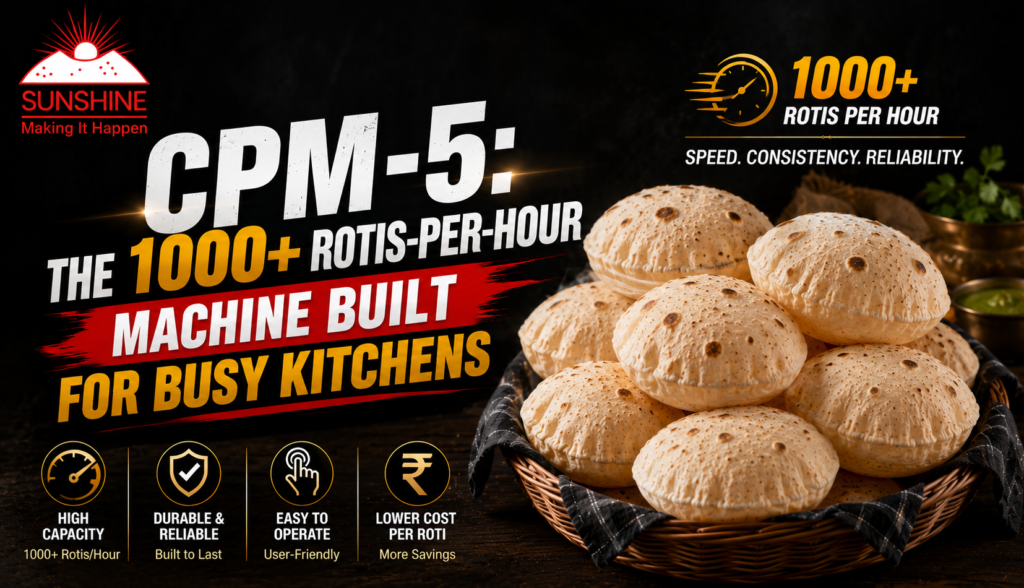
This is the exact problem the Sunshine CPM-5 is built to solve. It’s an automatic roti making machine capable of producing 1000+ rotis every hour, giving kitchens the kind of speed and consistency that manual rolling simply can’t match once volumes get large.
In this blog, we’ll break down what the CPM-5 actually does, who it’s built for, and why “1000 rotis an hour” matters a lot more than it might sound like at first.
What Does 1000+ Rotis an Hour Actually Mean for Your Kitchen?
It’s easy to read a number like “1000 rotis per hour” and move on without really thinking about what it means day to day. So let’s break it down in practical terms.
Imagine a busy lunch service where 300–400 people need to be served rotis within a tight window — say, a wedding hall, a large hostel dining hall, or a hotel’s peak lunch rush. Doing this by hand means putting several people on roti duty, all working at full speed, and still often falling behind as the crowd builds up.
With a machine producing over 1000 rotis an hour, that same rush becomes manageable with far fewer people involved in the roti-making process itself. Instead of scrambling to keep up, your kitchen can stay ahead of demand — which means shorter wait times for customers or guests, less stress on your staff, and a much smoother service overall, especially during your busiest hours of the day.
Who the CPM-5 Is Built For
The CPM-5 isn’t meant to be an everything-for-everyone machine — it’s specifically designed for kitchens that deal with real, consistent volume. Based on how kitchens typically use it, the CPM-5 tends to be the right fit for:
- Hotels and banquet kitchens that need to serve large numbers of guests within a fixed meal-service window.
- Hostels and PG messes feeding a large number of residents at set times every day.
- Catering businesses that take on weddings, corporate events, or large functions and need reliable, fast output without hiring a large temporary kitchen team.
- Dhabas and restaurants on busy highways or high-footfall locations where roti demand can spike suddenly and unpredictably.
- Canteens in offices, factories, or institutions that serve meals on a tight, repeating daily schedule.
If your kitchen regularly struggles to keep pace during meal rushes, or if you find yourself needing to hire extra roti-making staff just to survive your busiest hours, the CPM-5 is worth a serious look.
Why Consistency Matters as Much as Speed
Speed alone isn’t the whole story. A fast process that produces uneven, undercooked, or overcooked rotis isn’t actually solving your problem — it’s just creating a different one. This is where the CPM-5 earns its place: every roti that comes out goes through the same rolling and baking process, which means the 50th roti of the hour looks and tastes the same as the 950th.
For a business, this consistency matters in ways that go beyond taste. It means fewer complaints, less food waste from rejected or overcooked rotis, and a predictable experience for your customers or residents every single day — not just on your good days.
Less Physical Strain on Your Staff
Anyone who has spent time near a roti station during a lunch rush knows how physically demanding it is — the heat, the repetitive motion, the pressure of a growing line of hungry customers. Over time, this kind of work takes a real toll on staff, leading to fatigue, higher turnover, and inconsistent output as the day goes on.
By automating the bulk of the rolling and baking process, the CPM-5 takes a significant amount of that physical burden off your team. Staff can be redirected to tasks that genuinely need a human touch — plating, quality checks, managing the sabzi and dal stations, or handling customer-facing work — instead of standing over a hot tawa for hours at a stretch.
What Makes the CPM-5 Practical for Everyday Use
A high-output machine is only useful if it’s actually easy to run day after day. A few things that matter in daily operation:
- Straightforward operation, so kitchen staff don’t need extensive technical training to run it confidently.
- Reliable performance during long service hours, since a lunch or dinner rush doesn’t pause halfway through.
- Manageable cleaning and maintenance, so hygiene standards stay high without eating into staff time between services.
- A footprint that fits realistically into a working kitchen, not just a spec sheet — this is something worth discussing directly based on your kitchen’s layout.
How the Process Actually Works, in Simple Terms
You don’t need to be an engineer to understand what happens inside the CPM-5, and honestly, that’s part of the point — it’s designed so kitchen staff can operate it without a technical background. In simple terms, dough is fed into the machine, where it’s automatically portioned, rolled out evenly, and passed through a baking stage before coming out the other end as a finished roti, ready to be served.
What used to be three or four separate manual steps — portioning dough, rolling it out by hand, placing it on a tawa, flipping it at the right moment, and pulling it off before it burns — now happens as one continuous, automated process. The staff’s job shifts from doing every single step by hand to simply feeding the machine, keeping an eye on quality, and managing the output as it comes off the line.
Fitting the CPM-5 Into Your Existing Kitchen Routine
One thing kitchen owners often worry about before switching to automation is whether it will disrupt their existing routine. In practice, most kitchens find the opposite — the CPM-5 tends to slot into the busiest part of the day (typically breakfast, lunch, and dinner service windows) without requiring a complete overhaul of how the kitchen runs.
Staff who previously spent their entire shift on roti duty can be reassigned to prep work, plating, or other stations, while one or two people manage the machine itself. For kitchens running multiple meal services a day, this often means the same or smaller team can now comfortably handle a volume that used to require a much larger crew working flat out.
Maintenance and Day-to-Day Care
Like any kitchen equipment, the CPM-5 performs best with regular, simple maintenance — cleaning after each shift, checking that components are working smoothly, and following the recommended servicing schedule. None of this requires specialized technical staff; it’s designed to be manageable by a kitchen team as part of their normal closing routine, similar to cleaning any other major piece of kitchen equipment.
Keeping up with this routine care isn’t just about avoiding breakdowns — it also helps maintain consistent roti quality over the long run, which matters just as much six months after installation as it does on day one.
Thinking About ROI
For a lot of kitchen owners, the real question isn’t “can this machine make rotis fast” — it’s “does this actually save me money.” When you compare the ongoing cost of hiring, training, and retaining multiple roti-makers for peak hours against a one-time investment in a machine like the CPM-5, the math often works strongly in the machine’s favor, especially for businesses running high volumes multiple times a day, every day of the week.
Beyond direct labor costs, there’s also the cost of inconsistency — wasted dough, rejected rotis, and unhappy customers during a bad rush — all of which tend to drop significantly once output becomes automated and predictable.
Choosing Between CPM-5 and Other Sunshine Models
The CPM-5 sits in a specific place in the Sunshine lineup — built for kitchens that need strong, reliable output in the 1000+ rotis-per-hour range, without the larger footprint or output level of our bigger triple-conveyor machines. If your kitchen’s daily volume is closer to a few hundred rotis a day with occasional spikes, a smaller setup might be a better fit. If you’re running a very large operation needing 2000+ rotis an hour, one of our higher-capacity models may serve you better.
The honest answer is that the “right” machine depends entirely on your actual daily and peak-hour numbers, not just on choosing the biggest or most advanced option available. We’d always rather walk through your kitchen’s real volume with you and recommend the model that actually fits, instead of overselling capacity you don’t need.
Installation and Getting Your Team Comfortable
Bringing in a new machine is only half the job — the other half is making sure your team feels confident operating it from day one. When a CPM-5 is installed, the process typically includes setting up the machine to match your kitchen’s layout and workflow, along with hands-on training for your staff so they understand feeding, monitoring, and basic day-to-day care.
Most kitchens find that within the first few days of regular use, the machine becomes a normal part of the routine rather than something unfamiliar or intimidating. The goal isn’t just to hand over a machine — it’s to make sure your team is genuinely comfortable running it at full speed during your busiest hours, since that’s when it matters most.
A Few Common Questions
Is the CPM-5 only useful for very large kitchens? It’s built for kitchens that regularly need high volume, but “high volume” doesn’t only mean five-star hotels — busy dhabas, catering businesses, and institutional canteens all fall into this category.
Does automation reduce the quality or taste of the rotis? No — the process is built to replicate consistent rolling and baking, which often results in more even quality than manual rolling during a tired, rushed shift.
How much kitchen space is needed for the CPM-5? This depends on your specific kitchen layout and daily volume needs. It’s best to share your kitchen’s space and output requirements so the right configuration can be recommended.
Ready to Stop Falling Behind During Rush Hour?
If your kitchen’s biggest daily challenge is simply keeping up with demand during peak hours, the CPM-5 was built exactly for that problem. Reach out to us to talk through your kitchen’s volume and find out if the CPM-5 is the right fit.
📞 +91 95401 00399
🌐 www.sunshineindustries.co.in